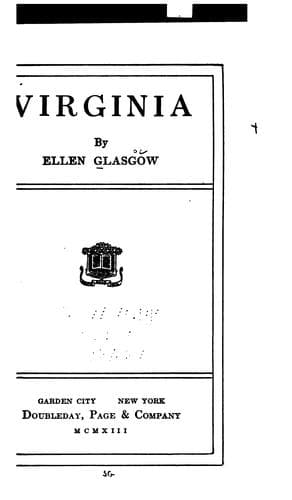
Marriage -- Fiction; Virginia -- Fiction; Wives -- Fiction; Women -- Fiction
But this was more than Cyrus could stand even from the rector, whose
conversation he usually tolerated because of the perverse, inexplicable
liking he felt for the man. The charm that Gabriel exercised over him
was almost feminine in its subtlety and in its utter defiance of any
rational sanction. It may have been that his nature, incapable though it
was of love, was not entirely devoid of the rarer capacity for
friendship--or it may have been that, with the inscrutable irony which
appears to control all human attractions, the caged brutality in his
heart was soothed by the unconscious flattery of the other's belief in
him. Now, however, he felt that Gabriel's highfaluting nonsense was
carrying him away. It was well enough to go on like that in the pulpit;
but on week days, when there was business to think of and every minute
might mean the loss of a dollar, there was no use dragging in either
religion or sentiment. Had he put his thoughts plainly, he would
probably have said: "That's not business, Gabriel. The trouble with
you--and with most of you old-fashioned Virginians--is that you don't
understand the first principles of business." These words, indeed, were
almost on his lips, when, catching the rector's innocent glance
wandering round to him, he contented himself with remarking satirically:
"Well, you were always up in the clouds. It doesn't hurt you, I reckon,
though I doubt if it does much toward keeping your pot boiling."
"I must turn off here," said Gabriel gently. "It's the shortest way to
Cross's Corner."
"Do you think any good will come of your going?"
"Probably not--but I couldn't refuse."
Much as he respected Cyrus, he was not sorry to part from him, for their
walk together had left him feeling suddenly old and incompetent to
battle with the problems of life. He knew that Cyrus, even though he
liked him, considered him a bit of a fool, and with a humility which was
unusual in him (for in his heart he was absolutely sure that his own
convictions were right and that Cyrus's were wrong) he began to ask
himself if, by any chance, the other's verdict could be secretly
justified. Was he in reality the failure that Cyrus believed him to be?
Or was it merely that he had drifted into that "depressing view" of
existence against which he so earnestly warned his parishioners? Perhaps
it wasn't Cyrus after all who had produced this effect. Perhaps the
touch of indigestion he had felt after dinner had not entirely
disappeared. Perhaps it meant that he was "getting on"--sixty-five his
last birthday. Perhaps--but already the March wind, fresh and
bud-scented, was blowing away his despondency. Already he was beginning
to feel again that fortifying conviction that whatever was unpleasant
could not possibly be natural.
Public-domain text, read in full here on John Shaqi.
Reviews
Reviews
No reviews yet
Be the first to share your thoughts on this work.
Elsewhere in the archive
Join the Discussion
Join the discussion
Sign in to leave a comment or review.
Sign InorCreate an account