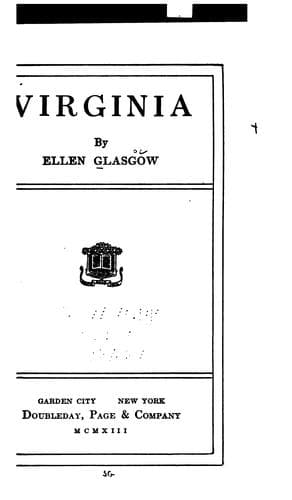
Marriage -- Fiction; Virginia -- Fiction; Wives -- Fiction; Women -- Fiction
There was nothing to do to-day; there would be nothing to do to-morrow;
and, unless Jenny came home to be married, there would be nothing to do
next year or the years after that. While Oliver was in Dinwiddie, she
had, of course, the pleasure of supplying his food and of watching him
eat it; but beyond that, even when he sat in the room with her, there
was little conversation between them. She herself loved to talk, for she
had inherited her mother's ability to keep up a honeyed flow of sound
about little things; but she had learned long ago that there were times
when her voice, rippling on about nothing, only irritated him, and with
her feminine genius for adaptability, she had made a habit of silence.
He never spoke to her of his work except in terms of flippant ridicule
which pained her, and the supreme topic of the children's school reports
had been absent now for many years. Companionship of a mental sort had
always been lacking between them, yet so reverently did she still accept
the traditional fictions of marriage, that she would have been
astonished at the suggestion that a love which could survive the shocks
of tragedy might at last fade away from a gradual decline of interest.
Nothing had happened. There had been no scenes, no quarrels, no
jealousies, no recriminations--merely a gentle, yet deliberate,
withdrawal of personalities. He had worshipped her at twenty-two, and
now, at forty-seven, there were moments when she realized with a stab of
pain that she bored him; but beyond this she had felt no cause for
unhappiness, and until the last year no cause even for apprehension.
The libertine had always been absent from his nature; and during all the
years of their marriage he had, as Susan put it, hardly so much as
looked at another woman. Whatever came between them, it would not be
physical passion, but a far subtler thing.
Going to his desk, she took up a photograph of Margaret Oldcastle and
studied it for a moment--not harshly, not critically, but with a pensive
questioning. It was hardly a beautiful face, but in its glowing
intellectuality, it was the face of a woman of power. So different was
the look of noble reticence it wore from that of the conventional type
of American actress, that while she gazed at it Virginia found herself
asking vaguely, "I wonder why she went on the stage?" The woman was not
a pretty doll--she was not a voluptuous enchantress--the coquetry of the
one and the flesh of the other were missing. If the stories Virginia had
heard of her were to be trusted, she had come out of poverty not by the
easy steps of managers' favours, but by hard work, self-denial, and
discipline. Though Virginia had never seen her, she felt instinctively
that she was an "honest woman."
Public-domain text, read in full here on John Shaqi.
Reviews
Reviews
No reviews yet
Be the first to share your thoughts on this work.
Elsewhere in the archive
Join the Discussion
Join the discussion
Sign in to leave a comment or review.
Sign InorCreate an account