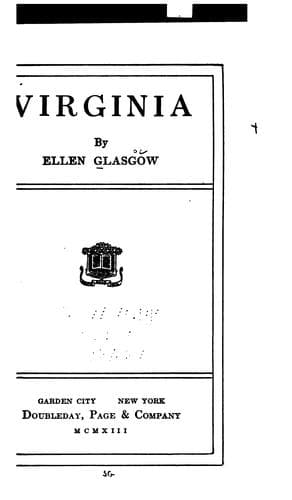
Marriage -- Fiction; Virginia -- Fiction; Wives -- Fiction; Women -- Fiction
"He will be sorry some day," she thought. "He will be sorry when it is
too late, and if I were there now--if I were to see him, it might all be
prevented. It might all be prevented and we might be happy again." In
her distorted mind, which worked with the quickness and the intensity of
delirium, this idea assumed presently the prominence and the force of an
hallucination. So powerful did it become that it triumphed over all the
qualities which had once constituted her character--over the patience,
the sweetness, the unselfish goodness--as easily as it obscured the
rashness and folly of the step which she planned. "If I could see him,
it might all be prevented," she repeated obstinately, as though some one
had opposed her; and, going upstairs to her bedroom, she packed her
little handbag and put on the travelling dress which she had worn in New
York. Then, very softly, as though she feared to be stopped by the
servants, she went down the stairs and out of the front door; and, very
softly, carrying her bag, she passed into the street and walked
hurriedly in the direction of the station. And all the way she was
thinking, "If I can only see him again, this may not happen and
everything may be as it was before when he still loved me." So just and
rational did this idea appear to her, that she found herself wondering
passionately why she had not thought of it before. It was so easy a way
out of her wretchedness that it seemed absurd of her to have overlooked
it. And this discovery filled her with such tremulous excitement, that
when she opened her purse to buy her ticket, her hands shook as if they
were palsied, and the porter, who held her bag, was obliged to count out
the money. The whole of life, which had looked so dark an hour ago, had
become suddenly illuminated.
Once in the train, her nervousness left her, and when an acquaintance
joined her after they had started, she was able to talk connectedly of
trivial occurrences in Dinwiddie. He was a fat, apoplectic looking man,
with a bald head which shone like satin, and a drooping moustache
slightly discoloured by tobacco. His appearance, which she had never
objected to before, seemed to her grotesque; but in spite of this, she
could smile almost naturally at his jokes, which she thought
inconceivably stupid.
"I suppose you heard about Cyrus Treadwell's accident," he said at last
when she rose to go to her berth. "Got knocked down by an automobile as
he was getting off a street car at the bank. It isn't serious, they say,
but he was pretty well stunned for a while."
"No, I hadn't heard," she answered, and thought, "I wonder why Susan
didn't tell me." Then she said good-night and disappeared behind the
curtains of her berth, where she lay, without undressing, until morning.
Public-domain text, read in full here on John Shaqi.
Reviews
Reviews
No reviews yet
Be the first to share your thoughts on this work.
Elsewhere in the archive
Join the Discussion
Join the discussion
Sign in to leave a comment or review.
Sign InorCreate an account