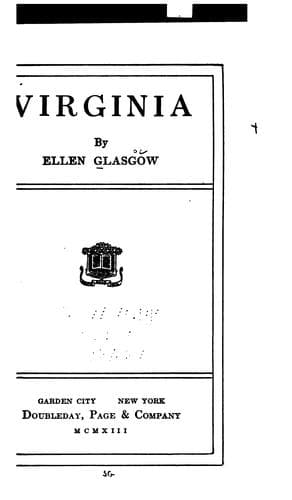
Marriage -- Fiction; Virginia -- Fiction; Wives -- Fiction; Women -- Fiction
Through the open window, beyond the drooping boughs of the paulownia
trees, a few wistful stars shone softly through the web of purple
twilight. The night smelt of a thousand flowers--all the mingled
sweetness of old gardens floated in on the warm wind and caressed the
faded figure of Miss Willy as lovingly as it did the young and radiant
vision of Virginia. Once or twice the kneeling seamstress had glanced up
at the girl and thought: "I wonder how it feels to be as lovely as
that?" Then she sighed as one who had missed her heritage, for she had
been always plain, and went on patiently sewing the bows on Virginia's
overskirt. "You can't have everything in this world, and I ought to be
thankful that I've kept out of the poorhouse," she added a minute later
when a little stab of envy went through her at hearing the girl laugh
from sheer happiness.
"Am I all right, mother? Tell me how I look."
"Lovely, darling. There won't be any one there sweeter than you are."
The maternal passion lit Mrs. Pendleton's eyes with splendour, and her
worn face was illuminated as if a lamp had been held suddenly close to
it. All day, in spite of a neuralgic pain in her temples, she had worked
hard hemming the flounces for Virginia's dress, and into every stitch
had gone something of the divine ecstasy of martyrdom. Her life centred
so entirely in her affections that apart from love she could be hardly
said to exist at all. In spite of her trials she was probably the
happiest woman in Dinwiddie, for she had found her happiness in the only
way it is ever won--by turning her back on it. Never once had she
thought of it as an end to be pursued, never even as a flower to be
plucked from the wayside. It is doubtful if she had ever stopped once in
the thirty years of her marriage to ask herself the questions: "Is this
what I want to do?" or "Does this make me happy?" Love meant to her not
grasping, but giving, and in serving others she had served herself
unawares. Even her besetting sin of "false pride" she indulged not on
her own account, but because she, who could be humble enough for
herself, could not bear to associate the virtue of humility with either
her husband or her daughter.
Public-domain text, read in full here on John Shaqi.
Reviews
Reviews
No reviews yet
Be the first to share your thoughts on this work.
Elsewhere in the archive
Join the Discussion
Join the discussion
Sign in to leave a comment or review.
Sign InorCreate an account