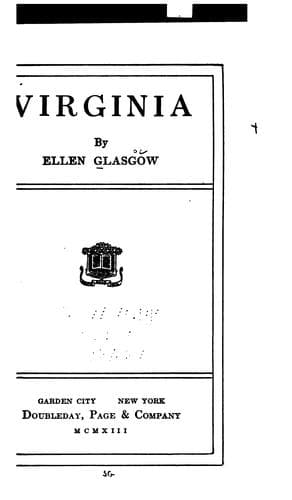
Marriage -- Fiction; Virginia -- Fiction; Wives -- Fiction; Women -- Fiction
Leaning there from the window, with her face lifted to the stars, and
her mother's worshipping gaze on her back, she thought of the
"happiness" which would be hers in the future: and this "happiness"
meant to her only the solitary experience of love. Like all the women of
her race, she had played gallantly and staked her world upon a single
chance. Whereas a man might have missed love and still have retained
life, with a woman love and life were interchangeable terms. That one
emotion represented not only her sole opportunity of joy, it constituted
as well her single field of activity. The chasm between marriage and
spinsterhood was as wide as the one between children and pickles. Yet so
secret was this intense absorption in the thought of romance, that Mrs.
Pendleton, forgetting her own girlhood, would have been startled had she
penetrated that lovely head and discovered the ecstatic dreams that
flocked through her daughter's brain. Though love was the one window
through which a woman might look on a larger world, she was fatuously
supposed neither to think of it nor to desire it until it had offered
itself unsolicited. Every girl born into the world was destined for a
heritage of love or of barrenness--yet she was forbidden to exert
herself either to invite the one or to avoid the other. For, in spite of
the fiery splendour of Southern womanhood during the war years, to be
feminine, in the eyes of the period, was to be morally passive.
"Your father has come to see your dress, dear," said her mother in the
voice of a woman from whom sentiment overflowed in every tone, in every
look, in every gesture.
Turning quickly, Virginia met the smiling eyes of the rector--those
young and visionary eyes, which Nature, with a wistful irony, had placed
beneath beetling brows in the creased and wrinkled face of an old man.
The eyes were those of a prophet--of one who had lived his life in the
light of a transcendent inspiration rather than by the prosaic rule of
practical reason; but the face belonged to a man who had aged before his
time under the accumulated stress of physical burdens.
"How do I look, father? Am I pretty?" asked Virginia, stretching her
thin young arms out on either side of her, and waiting with parted lips
to drink in his praise.
"Almost as beautiful as your mother, and she grows lovelier every day
that she lives, doesn't she?"
Public-domain text, read in full here on John Shaqi.
Reviews
Reviews
No reviews yet
Be the first to share your thoughts on this work.
Elsewhere in the archive
Join the Discussion
Join the discussion
Sign in to leave a comment or review.
Sign InorCreate an account