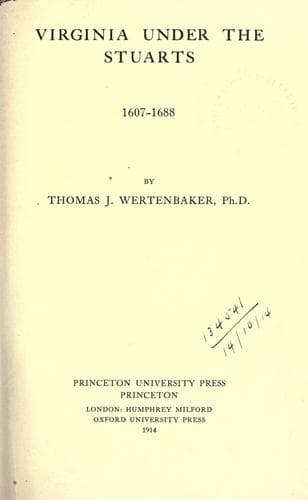
Virginia under the Stuarts 1607-1688Wertenbaker, Thomas Jefferson
History
Virginia under the Stuarts 1607-1688
Wertenbaker, Thomas Jefferson
Virginia -- History -- Colonial period, ca. 1600-1775
The restoration of the monarchy took place May 29th, 1660. When the news
reached Virginia some weeks later, the people accepted the change
without opposition, and probably with relief, for they were weary of
uncertainty and confusion. Berkeley's unaffected joy was mingled with a
deep apprehension that the King might be angered at his accepting office
without his consent. But Charles was not so unmindful of his staunch
support at a time when the fortunes of the monarchy were at their lowest
ebb as to reproach him for this act, which might, and probably did,
redound to his advantage. He soon relieved the Governor's fears by
sending a new commission. In a passion of joy and gratitude Berkeley
wrote his thanks. "I ... doe most humbly throwe myselfe at your Ma'ties
feet," he said, "in a dutifull thankfullness to your Majestie, that you
yett think me worthy of your Royall Commands. It is true, ... I did
something, which if misrepresented to your Majestie, may cause your
Majestie to think me guilty of a weakness I should ever abhor myself
for. But it was noe more ... than to leape over the fold to save your
Majesties flock, when your Majesties enemies of that fold had barred up
the lawfull entrance into it, and enclosed the Wolves of Scisme and
rebellion ready to devour all within it. Nor did I adventure on this,
without the advice and impulsion of your Majesties best Subjects in
these parts.... I always in all conditions had more fear of your
Majesties ffrownes than the Swords or Tortures of your Enemies."[379]
And so the Commonwealth period in Virginia came to an end. The colony
had benefited greatly by the eight years of semi-independence and
self-government. The population had increased rapidly. In 1649, there
had been about 15,000 people in Virginia, while six years after the
Restoration, the Governor estimated their number at 40,000. This great
gain was due chiefly to accelerated immigration from England. The
overthrow and execution of the King had sent many of his followers to
seek shelter with Sir William Berkeley, others had come to escape the
confusion and horrors of civil war, while the numerous prisoners taken
in battle had furnished abundant material for the never-ending stream of
indentured servants. Gentleman and tradesman and laborer alike were
welcome, for land was abundant and the colony's only need was men. Nor
was prosperity yet strangled by the strict enforcement of the Navigation
Acts. Dutch vessels continued to sail through the capes in defiance of
England and to carry off the planters' tobacco. Not until the closing
years of the Commonwealth period did the increasing freight rates and
the decreasing price of tobacco indicate that the "Hollanders" were
being more strictly excluded.[380]
Public-domain text, read in full here on John Shaqi.
Reviews
Reviews
No reviews yet
Be the first to share your thoughts on this work.
Elsewhere in the archive
Join the Discussion
Join the discussion
Sign in to leave a comment or review.
Sign InorCreate an account