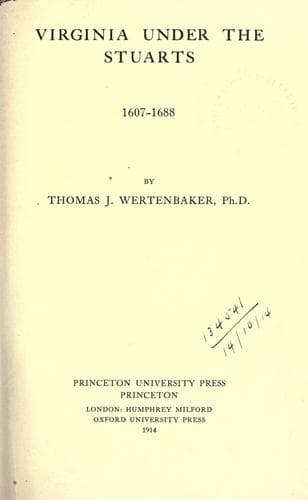
Virginia under the Stuarts 1607-1688Wertenbaker, Thomas Jefferson
History
Virginia under the Stuarts 1607-1688
Wertenbaker, Thomas Jefferson
Virginia -- History -- Colonial period, ca. 1600-1775
The agents, upon receiving these instructions, went to the Lords
Patentees to request them to resign the most obnoxious of their new
powers.[408] In case they refused, the agents threatened to appeal at
once to the King. Arlington and Culpeper received them courteously, and,
after numerous delays, consented to relinquish the patent, provided
Virginia would offer no objection to the passing of a new grant,
assuring them the quit-rents and escheated property. The agents were
well satisfied with this settlement, for it would relieve the colony of
its fear of proprietary government, while the grant of the rents and
escheats would impose little additional burden.[409]
In order, however, to prevent the giving away of such disturbing powers
in the future, they petitioned the King to grant "Letters Pattents for
the incorporacon" of the colony.[410] In this new charter they desired
first that permission be given Virginia to purchase the Northern Neck.
They next requested the King to promise that Virginia should have no
other dependence than upon the Crown of England, "nor in the future be
cantonized into parcells by grants made to particular persons". "And for
the prevention of surreptitious grants" they desired his Majesty to
promise in the charter that nothing should again pass concerning
Virginia until a hearing had been given to some person impowered by the
colony to represent their interests. Of even greater importance was
their desire, "That there shall bee no Taxe or Imposition layd on the
people of Virginia, but by their owne Consente, and that Express'd by
the Representatives in Assembly."[411]
The whole matter came before the King in Council, June 23, 1675, and was
referred to the judgment of Attorney-General William Jones and
Solicitor-General Francis Winnington.[412] In October these officers
reported that in their opinion the patent of incorporation would be
beneficial both to the colony and the King's service, and ought to be
granted. Charles thereupon gave directions that the papers be drawn up
for his signature. But here, for some unknown reason, the matter came to
a halt. Several months passed and the patent had not been issued.[413]
At last, April 19, 1676, at the urgent request of the agents, his
Majesty directed that the Lord Chancellor cause the papers to pass the
Great Seal at once. But before this could be done, news came to England
of Bacon's Rebellion, and the King immediately reversed his order.
Later, other Letters Patent were granted, but they were very different
from those sought by the agents, and contained little more than a bare
declaration of the colony's direct dependence upon the Crown of
England.[414]
Public-domain text, read in full here on John Shaqi.
Reviews
Reviews
No reviews yet
Be the first to share your thoughts on this work.
Elsewhere in the archive
Join the Discussion
Join the discussion
Sign in to leave a comment or review.
Sign InorCreate an account