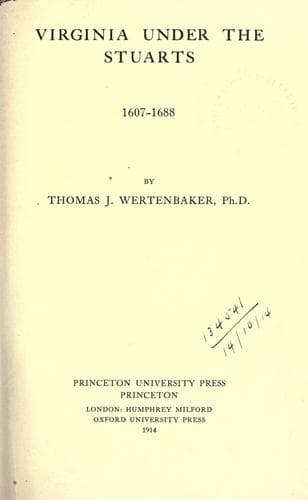
Virginia under the Stuarts 1607-1688Wertenbaker, Thomas Jefferson
History
Virginia under the Stuarts 1607-1688
Wertenbaker, Thomas Jefferson
Virginia -- History -- Colonial period, ca. 1600-1775
Great was the grief and rage of Sir William Berkeley when news of this
disaster reached him. How could he answer to the King for the loss of
the royal frigate and twenty English merchantmen? With great promptness
and resolution he decided to fit out all available vessels in the colony
for a sally upon the enemy. In the upper James were three merchantmen
and in the York nine. If these could be supplied quickly with guns and
men, there might yet be time to defeat the Dutch and rescue the captured
ships. The Governor, who was ever reckless in exposing his person,
resolved to direct the attack himself in the good ship _Admirall_. But
some of the masters by no means relished the thought of risking their
vessels and their cargoes in a battle with the Dutch. When the Governor
impressed them into the King's service by putting the broad arrow upon
their masts, they pretended obedience, but used such delays that the
fleet could not be prepared in time. Captain Lightfoot, of the
_Elizabeth_, grieved by the loss of his ship, "very passionately
resolved to hazard himself in the _Admirall_", while several members of
the Council and forty other gentlemen volunteered their services. Upon
the shore were assembled four regiments of militia, ready to embark
should they be needed. Yet the masters continued their procrastination
day after day until the Dutch escaped.
Nor had Admiral Crimson shown any haste to be off. Soon after the battle
he had burned five or six of the merchantmen, "for want of men to man
them". It had also been necessary for him to destroy the frigate, which
was still out of repair and far from seaworthy. He had sent parties
ashore several times to secure water, which he greatly needed, but they
had been driven back with ease. After a stay of five or six days in
James River, he sailed away with his prizes, leaving the Governor to
dismiss his militia and write home his accusations against the
masters.[422]
Warned by this experience, the English government, upon the outbreak of
the war of 1672, sent two men-of-war to Virginia. These vessels, in July
1673, were stationed at the mouth of the James guarding a large fleet of
merchantmen, when news came that nine Dutch warships were approaching
the capes. Instantly preparations were made to fight them. Several of
the tobacco ships were forced into service and fitted with guns. Sailors
were taken from the smaller vessels to help man the larger. But before
all could be put in readiness the enemy came through the capes and
anchored at Lynhaven Bay.[423]
Public-domain text, read in full here on John Shaqi.
Reviews
Reviews
No reviews yet
Be the first to share your thoughts on this work.
Elsewhere in the archive
Join the Discussion
Join the discussion
Sign in to leave a comment or review.
Sign InorCreate an account