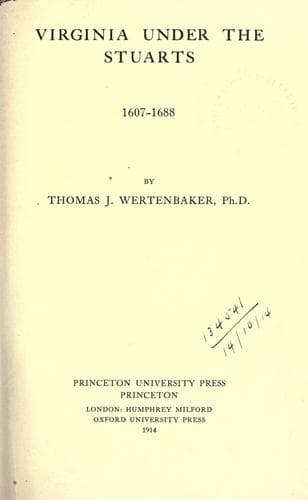
Virginia under the Stuarts 1607-1688Wertenbaker, Thomas Jefferson
History
Virginia under the Stuarts 1607-1688
Wertenbaker, Thomas Jefferson
Virginia -- History -- Colonial period, ca. 1600-1775
In the midst of the second Dutch war came another scourge no less
distressing than the great hurricane. Throughout the 17th century cattle
raising was one of the most important industries of the small Virginia
proprietors. No planter, however insignificant his holdings, was without
his cow and his calf.[428] They constituted a most important portion of
his wealth, and an indispensable source of support. In the winter of
1672-3 occurred an epidemic which destroyed more than half the cattle
of Virginia. The mortality was increased by the cold, which was
unusually severe. Many men, in an effort to preserve the poor beasts,
gave them all their corn and thus brought hunger upon themselves. Before
relief came with the spring, fifty thousand cattle had perished.[429]
Perhaps the people of Virginia might have borne patiently all these
misfortunes, had their Governor ruled them with wisdom and justice.
Certain it is they would never have turned in wild anger to strike down
his government, had that government not done much to make their
condition intolerable. Sir William Berkeley was accused of destroying
the representative character of the Assembly, of initiating a notorious
spoils system, of intimidating Burgesses, of winking at embezzlement of
public funds. And, although most of these charges were brought by the
Governor's bitter enemies, some of them were undoubtedly true.
In Virginia, during this period, the commons could guard their interests
only by means of the House of Burgesses. All other organs of government
were controlled by Berkeley and his friends. The people had no voice in
the selection of vestrymen, or sheriffs, or justices of the peace, and
no control over their actions. The Council was entirely submissive to
the Governor's will. Its members not only held their seats at Sir
William's pleasure, but were the recipients of numerous other favors
that bound them closely to his interest. Thus in the executive, in all
branches of the judiciary, and in the upper house of Assembly the
Governor was all-powerful.
If then he could control the Burgesses and make them subservient to his
desires, he would remove the only obstacle to almost complete despotism.
Nor was it a matter of very great difficulty for him to gain a mastery
of the House. In every county he could nominate government candidates,
and exert tremendous pressure to secure their election. If necessary,
they might be seated by fraud at the polls or false returns by the
sheriff.[430] "It is true," Bacon declared, "that the people's hopes of
redemption did ly in the Assembly, as their Trusts, and Sanctuary to fly
to, but I would have all men consider first how poore people are
debarred of their fair election, the great men in many places haveing
the Country in their debte and consequently in their aw. Secondly how
meanly we are provided of men of Learning, ability and courage, nay
indeed of honesty, to stand up in the people's behalf and oppose the
oppressing party."[431]
Public-domain text, read in full here on John Shaqi.
Reviews
Reviews
No reviews yet
Be the first to share your thoughts on this work.
Elsewhere in the archive
Join the Discussion
Join the discussion
Sign in to leave a comment or review.
Sign InorCreate an account