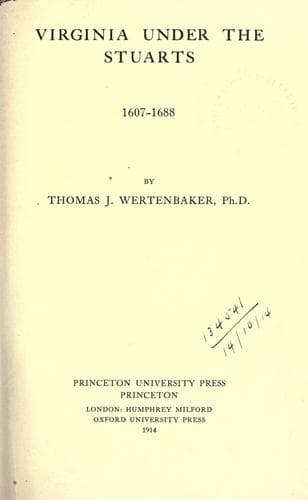
Virginia under the Stuarts 1607-1688Wertenbaker, Thomas Jefferson
History
Virginia under the Stuarts 1607-1688
Wertenbaker, Thomas Jefferson
Virginia -- History -- Colonial period, ca. 1600-1775
The universal discontent was still further increased by the wasteful and
lax use of public funds. The money which was wrung from the poor people
by these unequal taxes, was seldom wisely or economically expended. Much
was squandered upon foolish projects, costly in the extreme, and
impossible of accomplishment. Such was the attempt to build a city at
Jamestown. For many years it had been a matter of regret to the English
government that Virginia should remain so entirely a rural country. Not
realizing that this was but the result of exceptional economic
conditions and not a sign of weakness or decay, they sought more than
once to force the building of towns by legislative enactments. Thus, in
1662, in accordance with the King's wishes, the Assembly passed an act
providing for the erection of thirty-two brick houses at Jamestown.[453]
Each county was required to build one of these houses, a levy of thirty
pounds of tobacco per poll being laid for that purpose. This attempt was
foredoomed to failure, for if economic conditions could not develop
cities in the colony, the mere erection of houses upon the unhealthful
Jamestown peninsula could accomplish nothing. We learn from Bacon's
Proceedings that the town at the time of the Rebellion consisted of "som
16 or 18 howses, ... and in them about a dozen families (for all the
howses are not inhabited) getting their liveings by keeping ordnaries,
at extraordnary rates". That there was corruption or inefficiency in
carrying out the orders of the Assembly seems certain. The people of
Isle of Wight county complained of "the great Quantities of Tobacco
levyed for Building Houses of publick use and reception at Jamestown,
which were not habitable, but fell downe before the Finishing of
them".[454]
There were also accusations of laxness and fraud in the erecting and
management of the public industrial plants. Very grievous taxes have
been laid on the poor people, it was claimed, "for building work houses
and stoare houses and other houses for the propogating & encouragem't of
handicraft and manufactury, which were by our Burgesses to our great
charge and burthen by their long and frequent sitting invented and
proposed. Yet for want of due care the said houses were never finished
or made useful, and the propagating & manufactury wholy in a short time
neglected, and noe good ever effected ... save the particular profitt of
the Undertakers, who (as is usually in such cases) were largely rewarded
for thus defrauding us."[455]
Public-domain text, read in full here on John Shaqi.
Reviews
Reviews
No reviews yet
Be the first to share your thoughts on this work.
Elsewhere in the archive
Join the Discussion
Join the discussion
Sign in to leave a comment or review.
Sign InorCreate an account