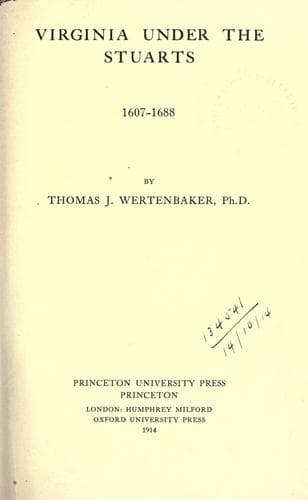
Virginia under the Stuarts 1607-1688Wertenbaker, Thomas Jefferson
History
Virginia under the Stuarts 1607-1688
Wertenbaker, Thomas Jefferson
Virginia -- History -- Colonial period, ca. 1600-1775
It would not be just to give credence to all the accusations made
against Berkeley. The King's commissioners who conducted the
investigation into his conduct, were his enemies; while many of the
charges were brought by those who had taken part in the Rebellion. Thus
the testimony against him is in most cases distinctly partisan. Moreover
those that were closely associated with Sir William often expressed
extravagant admiration for his ability and energy, and love for his
character.[463] "He hath," wrote the Council in 1673, "for neare 30
years governed this colony with that prudence and justice which hath
gained him both love and reverence from all the Inhabitants here."[464]
Singularly enough Berkeley seems to have prided himself upon his ability
as a ruler. He never forgot the compliment paid him by the people in
1660, when they insisted, even against his will, upon making him their
Governor. And long after he had forfeited their confidence and esteem he
imagined himself as popular as in his first administration. It was a
bitter blow to his pride when the commons rose against his government in
1676. His proclamations bear testimony to his pain that the youthful
Bacon should have usurped his place in the affections of the
people.[465] His letter to the King asking to be recalled from his
government was undoubtedly dictated by wounded pride. Upon the eve of
his final departure for England he did not scruple to write Colonel
Jeffreys, "I will confesse to you that I beleeve that the Inhabitants of
this Colony wil quickly find a difference betweene your management and
mine."[466]
It would be difficult to reconcile this attitude of mind with Berkeley's
oppressive administration, did we not know his views upon governmental
matters. He had never been in sympathy with republican institutions. It
was the height of folly, he thought, to allow the people to participate
either in administrative or legislative affairs. The King alone should
rule; the people's duty was to obey. It was but five years before the
Rebellion that he wrote to the Lords of Trade and Plantations, "I thanke
God there is noe ffree schooles nor printing (in Virginia)[467] and I
hope wee shall not have these hundred yeares, for learning has brought
disobedience & heresaye and sects into the world and printing has
divulged them, and libells against the best Government: God keepe us
from both."[468] A man that could utter such sentiments as these would
not scruple to throttle, if he could, all representative institutions in
his government. If he intimidated voters and corrupted the Burgesses, it
was perhaps because he thought himself justified in any measures that
would render the Governor, the King's substitute, supreme in the
government.
Public-domain text, read in full here on John Shaqi.
Reviews
Reviews
No reviews yet
Be the first to share your thoughts on this work.
Elsewhere in the archive
Join the Discussion
Join the discussion
Sign in to leave a comment or review.
Sign InorCreate an account