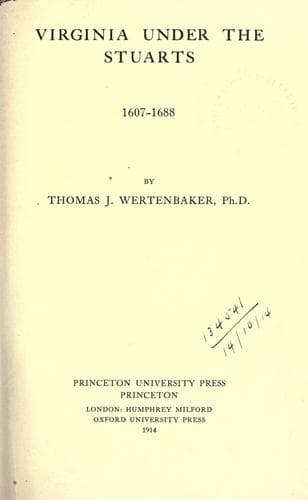
Virginia under the Stuarts 1607-1688Wertenbaker, Thomas Jefferson
History
Virginia under the Stuarts 1607-1688
Wertenbaker, Thomas Jefferson
Virginia -- History -- Colonial period, ca. 1600-1775
Bacon made up his mind to fight. The dense woods, the many swamps and
creeks, the vast distances of the colony would all be favorable to him.
He would resort to the Indian method of fighting. His men were as brave
as the British; were better marksmen. Five hundred Virginians, he was
sure, would be a match for two thousand red coats. If England sought to
bring him to his knees, by blockading the coast and cutting off all
foreign trade, he would appeal to the Dutch or even to the French for
assistance. Assuredly these nations would not neglect so favorable an
opportunity of injuring their old rival and enemy. He even cherished a
wild dream of leading his rebels back into the woods, to establish a
colony upon an island in the Roanoke river.[623]
But Bacon knew that the people would hesitate to follow him into open
resistance to England. Ties of blood, of religion, of interest were too
strong. All the injustice done them by the King, all the oppression of
the Navigation Acts, could not make them forget that they were
Englishmen. So he found it necessary to deceive them with a pretence of
loyalty. He himself took the oath of allegiance and supremacy, and he
imposed it upon all his followers. His commands were issued in the
King's name. He even went to the absurd extremity of declaring it for
the service of the Crown to disobey the King's commands, to arrest the
King's Governor, to fight the King's troops.[624]
Realizing that resistance to his plans would come almost entirely from
the upper classes, Bacon made especial efforts to seduce the wealthy
planters. On August the third, a number of influential gentlemen
assembled upon his summons at Middle Plantation, to discuss the means of
protecting the people from the Indians, and preventing civil war. After
delivering a long harangue, justifying his own actions and denouncing
the Governor, Bacon requested the entire company to take three oaths
which he had prepared. First, they were to promise to assist him in
prosecuting the Indian war. Secondly, they must combat all attempts of
the Governor and his friends to raise troops against him. Thirdly, they
were asked to declare it consistent with their allegiance to the King to
resist the royal troops until his Majesty could be informed by letter
from Bacon of the justice of his cause.[625] This last article caused
prolonged and bitter controversy. But Bacon locked the doors, it is
said, and by persuasion and threats induced them all to sign. The three
oaths were taken by no less than sixty-nine prominent men, among them
Thomas Swann, Thomas Milner, Philip Lightfoot and Thomas Ballard.[626]
Public-domain text, read in full here on John Shaqi.
Reviews
Reviews
No reviews yet
Be the first to share your thoughts on this work.
Elsewhere in the archive
Join the Discussion
Join the discussion
Sign in to leave a comment or review.
Sign InorCreate an account