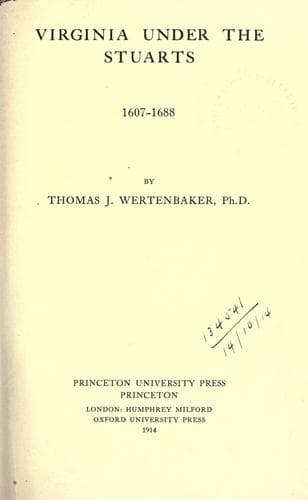
Virginia under the Stuarts 1607-1688Wertenbaker, Thomas Jefferson
History
Virginia under the Stuarts 1607-1688
Wertenbaker, Thomas Jefferson
Virginia -- History -- Colonial period, ca. 1600-1775
Almost simultaneously in all other parts of the colony the rebellion
collapsed. The defeats of the Governor in Gloucester, Middlesex and York
had not long postponed the end. The failure of the movement was due, not
to military successes by Berkeley, but to hopeless internal weakness.
Since the death of Bacon the insurgent leaders had been unable to
maintain law and order in the colony. Ingram, although he showed some
ability as a general, proved utterly unfitted to assume control of civil
affairs. Bacon, when Sir William fled to Accomac, had grasped firmly the
reins of government, calling a part of the Council to his assistance,
summoning a new Assembly, and retaining sheriffs and justices in their
offices. Like Cromwell, he had shown himself not only a soldier, but a
civil ruler of force and ability. But Ingram could not command the
respect and obedience of the people. Under him the machinery of
government seems to have broken down. The unhappy colony was given over
to disorder and anarchy. We are inclined to wonder why Drummond or
Lawrence did not assume the chief command in the government after
Bacon's death. Both were men of intelligence and ability, both esteemed
by the people, and both devoted heart and soul to the rebellion. For
some reason, neither could take the leadership, and affairs fell into
hopeless confusion.
Without a government to supply their needs, or to direct their
movements, the rebel bands found it necessary to maintain themselves by
plundering the estates of the Governor's friends. Many wealthy planters
paid for their loyalty with the loss of their cattle, their sheep, their
corn and wheat, and often the very furniture of their houses. At times
the rebel officers could not restrain their rough soldiers from wanton
waste and destruction. Crops were ruined, fences thrown down, houses
burned.[706] Disgusted with this anarchy, and seeing that Ingram could
not preserve order, many of the people began to long for the end of the
rebellion. Even the misgoverment of Berkeley was better than lawlessness
and confusion.
Ingram himself seems to have perceived that the end was at hand.
Intelligence came to him that some of his own party, dissatisfied with
his conduct, were awaiting an opportunity to deprive him of the chief
command. The long expected arrival of the English troops would bring
swift and complete ruin, for under the present conditions, he could not
hope for success against them. So he soon became quite willing "to
dismount from the back of that horse which he wanted skill, and strength
to Manidge". Could he but secure a pardon from the Governor, he would
gladly desert the failing cause of the people, and return to his
allegiance.[707]
Public-domain text, read in full here on John Shaqi.
Reviews
Reviews
No reviews yet
Be the first to share your thoughts on this work.
Elsewhere in the archive
Join the Discussion
Join the discussion
Sign in to leave a comment or review.
Sign InorCreate an account