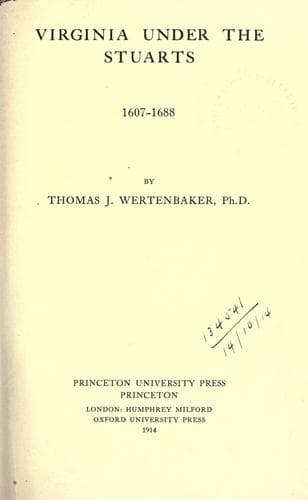
Virginia under the Stuarts 1607-1688Wertenbaker, Thomas Jefferson
History
Virginia under the Stuarts 1607-1688
Wertenbaker, Thomas Jefferson
Virginia -- History -- Colonial period, ca. 1600-1775
Nor could the people expect relief or justice from the General Assembly
which met at Green Spring, February the twentieth, 1677.[775] The
elections had been held soon after the final collapse of the Rebellion,
amid the general terror inspired by the numerous executions, and had
resulted in an overwhelming victory for the loyalists. In many counties,
staunch friends of the Governor had been put in nomination, and the
commons given an opportunity of showing the sincerity of their
repentance by electing them to the Assembly. William Sherwood declared
that most of the Burgesses were Berkeley's "owne Creatures & choase by
his appointments before the arrivall of the Commissioners".[776] In
several places fraud as well as intimidation seems to have been used to
secure the election of loyalists. The commons of Charles City complained
that there had been illegal voting in their county and seventy of them
signed a petition, demanding a new election, which they posted upon the
court house door.[777] That the Assembly was in no sense representative
of the people seems to have been recognized even in England, for some of
the King's ministers declared that it had been "called when ye Country
was yet remaining under great distractions, and uncapable of making
their Elections after ye usual manner".[778]
Certain it is, that the House of Burgesses as well as the Council, was
filled with ardent loyalists and friends of the Governor. They passed
several acts confirming all Berkeley's recent measures, and inflicting
further punishment upon the luckless rebels.[779] Some that had escaped
the gallows were forced to pay heavy fines, others were banished.[780]
Many were compelled to make humble submission, with ropes around their
necks, upon their knees before the Governor or the county magistrates.
Large sums of money were voted to reward the most active of Berkeley's
supporters. All that had held command among the rebels, even Ingram and
Walkelett, were made forever "incapable of any office civil or military
in Virginia". To speak ill of the Governor and Council or of the
justices of the peace, was declared a high crime, punishable by
whipping. If the people, to the number of six, assembled in arms, they
were to be considered mutineers and rebels. And the Burgesses showed
great reluctance to reduce their own salaries, which the people
considered so excessive. The Governor feared to insist upon it, "least
perhaps he might thereby disoblige and thwart his own ends and interest
in the Assembly", and only the positive commands of the King, delivered
to them by the commissioners, could induce them to make any reduction at
all.[781]
Public-domain text, read in full here on John Shaqi.
Reviews
Reviews
No reviews yet
Be the first to share your thoughts on this work.
Elsewhere in the archive
Join the Discussion
Join the discussion
Sign in to leave a comment or review.
Sign InorCreate an account