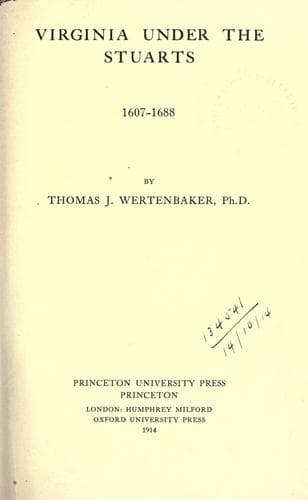
Virginia under the Stuarts 1607-1688Wertenbaker, Thomas Jefferson
History
Virginia under the Stuarts 1607-1688
Wertenbaker, Thomas Jefferson
Virginia -- History -- Colonial period, ca. 1600-1775
In their work of investigation the commissioners found that they had
need of the records of the House of Burgesses. In April, 1677, after the
adjournment of the session at Green Spring, they came to Major Robert
Beverley, the clerk of the Assembly, and demanded "all the Originall
Journals, Orders, Acts", etc., then in his custody.[823] Beverley
required them to show their authority, and this they did, by giving him
a sight of that part of their commission which concerned his delivery
of the records.[824] He then offered to allow them to examine any of the
papers necessary to the investigation, but he refused absolutely to
relinquish their custody.[825] The commissioners, who distrusted
Beverley and perhaps feared that he might conceal the records, "took
them from him by violence".[826]
When the Assembly met in October, 1677, the House of Burgesses sent a
vigorous protest to Colonel Jeffreys against these proceedings of the
commissioners. Their action, they declared, "we take to be a great
violation of our privileges". The power to command the records which the
commissioners claim to have received from the King, "this House humbly
suppose His Majesty would not grant or Comand, for that they find not
the same to have been practiced by any of the Kings of England in the
likewise.... The House do humbly pray your Honour ... will please to
give the House such satisfaction, that they may be assured no such
violation of their privileges shall be offered for the future."[827]
When Charles II heard of this bold protest he was surprised and angered.
It seemed to him a "great presumption of ye said Assembly ... to call in
Question" his authority.[828] Referring their representation to the
Lords of Trade and Plantations, he directed them "to examine ye same, &
to Report" what they thought "fitt to be done in Vindication of ...
(the) Royall Authority, & for bringing the said Assembly to a due sence
& acknowledgement of their Duty & Submission".[829] The Lords gave it as
their opinion that the declaration was so "Seditious, even tending to
Rebellion", that the new Governor should be directed to rebuke the
Assembly and punish the "authors and abettors of this presumption".[830]
The King commanded Lord Culpeper to carry these recommendations into
effect. On the third of July, 1680, Culpeper brought the matter before
the Virginia Council, preparatory to delivering the rebuke. But the
Councillors made a vigorous defense of the action of the Assembly, and
unanimously advised the Governor to suspend the execution of the King's
command.[831] After some hesitation, Culpeper yielded, and the matter
was referred back to the Privy Council. Charles was finally induced to
rescind the order, but he insisted that all reference to the declaration
"be taken off the file and razed out of the books of Virginia".[832]
Public-domain text, read in full here on John Shaqi.
Reviews
Reviews
No reviews yet
Be the first to share your thoughts on this work.
Elsewhere in the archive
Join the Discussion
Join the discussion
Sign in to leave a comment or review.
Sign InorCreate an account