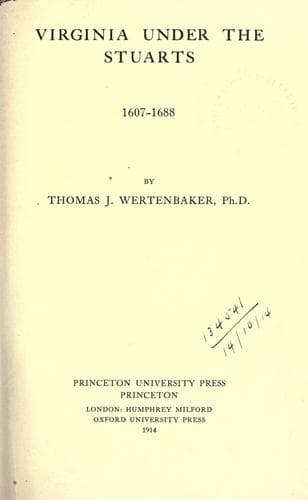
Virginia under the Stuarts 1607-1688Wertenbaker, Thomas Jefferson
History
Virginia under the Stuarts 1607-1688
Wertenbaker, Thomas Jefferson
Virginia -- History -- Colonial period, ca. 1600-1775
"By this means," wrote Colonel Daniel Parke, "and by persuading the
burgesses that Sir William Berkeley was coming in Governour again, (the
loyal party) got all confirmed that was done at the Assembly before held
at Greene Spring."[857] In order to compensate themselves for their
great losses and to fulfil the promises made by Berkeley to his
followers during the Rebellion, they levied a tax upon the people of
one hundred and ten pounds of tobacco per poll. "This with the county
tax and parish tax," said Parke, "is in some counties 250lbs, in some
300, and in some 400lbs, which falls very heavie upon the poorer
people." The county grievances were again rejected by the Burgesses as
false and scandalous, and the persons presenting them were severely
punished.[858] But the Assembly expressed an earnest desire to bring
about a reconciliation between the hostile factions in the colony, and
prescribed a heavy penalty for the use of such opprobrious epithets as
"traytor, Rebell Rougue, Rebell", etc.[859]
The news of Berkeley's death was a severe blow to the Green Spring
party. All the hope they had entertained that he would accomplish the
overthrow of the work of the commissioners, at once fell to the ground.
But they were somewhat consoled by the appointment of Lord Culpeper.
This nobleman was related to Lady Berkeley, and they had good reason to
believe he would reverse the policy of the present administration and
ally himself with the loyalists.[860]
In the meanwhile the Lieutenant-Governor was regaining his health and
spirits, and was taking a more active part in public affairs. He had
been deeply angered with Colonel Philip Ludwell for his many insults,
and he now determined to prosecute him "for scandalizing the Governor,
and abusing the Authority of his Majesty".[861] Ludwell's unpardonable
crime, it would seem, consisted in calling Jeffreys "a pitiful little
Fellow with a perriwig".[862] He had also been heard to say that the
Lieutenant-Governor was "a worse Rebel than Bacon", that he had broken
the laws of Virginia, that he had perjured himself, that he "was not
worth a Groat in England". Nor was it considered a sufficient excuse
that Ludwell had made those remarks immediately after consuming "part of
a Flaggon of Syder".[863] The jury found him guilty of "scandalizing the
Governor", but acquitted him of any intention of abusing his Majesty's
authority. The General Court, upon the motion of Colonel Jeffreys,
referred the case to the King and Privy Council, that they might "advise
a punishment proportionable to the offence".[864] Against this decision
the defendant, as he had an undoubted right to do, appealed to the
General Assembly. Ludwell felt, no doubt, that should the appeal be
allowed, his great influence in the House of Burgesses would secure him
a light sentence. But the court declared the case so unprecedented that
the whole matter, including the question of appeal, must be decided by
the King.
Public-domain text, read in full here on John Shaqi.
Reviews
Reviews
No reviews yet
Be the first to share your thoughts on this work.
Elsewhere in the archive
Join the Discussion
Join the discussion
Sign in to leave a comment or review.
Sign InorCreate an account