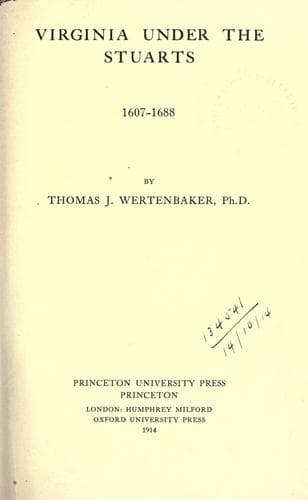
Virginia under the Stuarts 1607-1688Wertenbaker, Thomas Jefferson
History
Virginia under the Stuarts 1607-1688
Wertenbaker, Thomas Jefferson
Virginia -- History -- Colonial period, ca. 1600-1775
For some years after the Restoration the administration of English
colonial affairs had been very lax. The Council of Plantations, which
had served as a Colonial Office during the period from 1660 to 1672, had
done little to control the Governors or to supervise and direct their
policies. With the exception of one list of questions sent to Virginia
in 1670, they had left Sir William Berkeley almost entirely to his own
devices. September 27, 1672, the Council of Plantations was united with
the Board of Domestic Trade to form the Council of Trade and
Plantations. This new arrangement seems not to have been productive of
good results, for in December, 1674, after the fall of the Cabal
ministry, it was discontinued and the direction of colonial affairs
entrusted to the King's Privy Council. This important body, finding its
new duties very onerous, created a committee of twenty-one members, to
whom the supervision of trade and plantations was assigned. In this way
the King's most trusted ministers were brought into close touch with
colonial affairs. We find now such prominent statesmen as Secretary
Coventry, Secretary Williamson and Sir Lionel Jenkins carrying on
extensive correspondence with the Governors, becoming interested in all
their problems and needs, and demanding copies of all journals of
Assembly and other state papers.[882]
This closer intimacy with the colonial governments led inevitably to a
feeling of intolerance for local autonomy and for representative
institutions, and to a determination to force upon the colonists a
conformity with the policies and desires of the English government.
Charles II and James II, instituted, in the decade preceding the English
Revolution, a series of measures designed to curb the independence of
the colonists. Some of the Assembly's long-established and most
important rights were attacked. Many of its statutes were annulled by
proclamation; its judicial powers were forever abolished; its control
over taxation and expenditure was threatened; the privilege of selecting
the Assembly clerk was taken from it; while even the right to initiate
legislation was assailed.
The intolerant mood of the King and Privy Council is reflected in the
instructions given Lord Culpeper upon his departure for Virginia. They
included orders depriving him of the power, exercised freely by all
former Governors, of calling sessions of the Assembly. "It is Our Will
and pleasure," Charles declared, "that for the future noe General
Assembly be called without Our special directions, but that, upon
occasion, you doe acquaint us by letter, with the necessity of calling
such an Assembly, and pray Our consent, and directions for their
meeting."[883]
Public-domain text, read in full here on John Shaqi.
Reviews
Reviews
No reviews yet
Be the first to share your thoughts on this work.
Elsewhere in the archive
Join the Discussion
Join the discussion
Sign in to leave a comment or review.
Sign InorCreate an account