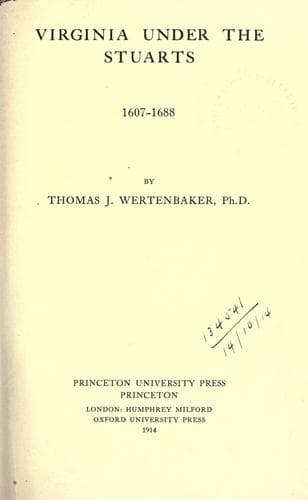
Virginia under the Stuarts 1607-1688Wertenbaker, Thomas Jefferson
History
Virginia under the Stuarts 1607-1688
Wertenbaker, Thomas Jefferson
Virginia -- History -- Colonial period, ca. 1600-1775
As a last hope the Company resolved to seek the assistance of
Parliament. A petition was drawn up to be presented to the Commons, and
the shareholders that were members of that body were requested to give
it their strenuous support when it came up for consideration. The
petition referred to Virginia as a "child of the Kingdom, exposed as in
the wilderness to extreme danger and as it were fainting and labouring
for life", and it prayed the House to hear "the grievances of the Colony
and Company, and grant them redress".[216] The matter was brought before
the Commons in May, 1624, but before it could be considered, a message
was received from the King warning them "not to trouble themselves with
this petition as their doing so could produce nothing but a further
increase Schisme and factions in the Company". "Ourself," he announced,
"will make it our own work to settle the quiet, and wellfare of the
plantations."[217] This was received with some "soft mutterings" by the
Commons, but they thought it best to comply, and the Company was left to
its fate.[218]
In the meanwhile the King had placed his case in the hands of
Attorney-General Coventry, who had prepared a _quo warranto_ against the
Company.[219] Although all hope of retaining the charter was gone, the
Sandys party were determined to fight to the end. They voted to employ
attorneys and to plead their case before the King's Bench. The _quo
warranto_ came up June 26th, 1624, and "the Virginia Patent was
overthrown", on a mistake in pleading.[220] With this judgment the
London Company practically ceased to exist, and Virginia became a royal
province.
FOOTNOTES:
[117] F. R., p. 6.
[118] F. R., p. 76.
[119] Gen., p. 1027.
[120] F. R., p. 265.
[121] F. R., p. 271.
[122] Gen., p. 339.
[123] F. R., p. 6.
[124] Gen. p. 236. Compare F. R., pp. 262, 263, 264, 31, 248, 80; Gen.,
pp. 49, 146.
[125] F. R., p. 80.
[126] F. R., p. 49.
[127] Gen., p. 50.
[128] Gen., p. 355.
[129] F. R., p. 558.
[130] F. R., p. 85.
[131] F. R., p. 237.
[132] F. R., vi.
[133] F. R., p. 251.
[134] F. R., p. 75.
[135] Gen., pp. 60, 61.
[136] Arb. Smith, lxxxiii.
[137] F. R., p. 266.
[138] F. R., p. 266.
[139] F. R., pp. 281, 282.
[140] F. R., p. 293.
[141] F. R., p. 312.
[142] F. R., p. 315.
[143] Nar. of Va., pp. 249, 250.
[144] Nar. of Va., p. 251.
[145] F. R., p. 317.
[146] Nar. of Va., pp. 252, 253, 254, 255, 260, 261.
[147] Nar. of Va., p. 276.
[148] In 1662 the Assembly granted power to the Governor and Council for
three years to levy a small tax by the poll. The county taxes for
defraying local expenses, were assessed and collected by the justices of
the peace. The vestries controlled the raising of the parish dues.
[149] Miller, p. 41.
[150] F. R., p. 376.
[151] F. R., p. 415.
[152] F. R., p. 464.
[153] F. R., p. 612.
[154] Bruce, Ec. Hist., Vol. II, pp. 448, 449.
[155] _Ibid._
[156] Bruce, Ec. Hist., Vol. II, pp. 442, 443.
[157] F. R., p. 322.
[158] F. R., p. 335.
Public-domain text, read in full here on John Shaqi.
Reviews
Reviews
No reviews yet
Be the first to share your thoughts on this work.
Join the Discussion
Join the discussion
Sign in to leave a comment or review.
Sign InorCreate an account