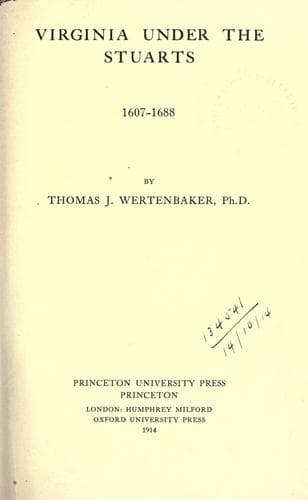
Virginia under the Stuarts 1607-1688Wertenbaker, Thomas Jefferson
History
Virginia under the Stuarts 1607-1688
Wertenbaker, Thomas Jefferson
Virginia -- History -- Colonial period, ca. 1600-1775
They met with scant courtesy. The planters thought it a hard matter that
they should be ordered to aid in the establishment of this new colony.
They resented the encroachment upon their territories, they hated the
newcomers because most of them were Catholics, they feared the loss of a
part of their Indian trade, and they foresaw the growth of a dangerous
rival in the culture of tobacco. Despite the King's letter they refused
to help Calvert and his men. "Many are so averse," wrote Harvey, "that
they crye and make it their familiar talke that they would rather knock
their Cattell on the heades than sell them to Maryland."[271] The
Governor, however, not daring to disobey his sovereign's commands, gave
the visitors all the assistance in his power. "For their present
accomodation," he said, "I sent unto them some Cowes of myne owne, and
will do my best to procure more, or any thinge else they stand in need
of."[272] This action secured for Harvey the praise of the Privy
Council, but it made him more unpopular with his Council and the people
of Virginia.
After a stay of several weeks at Point Comfort, Calvert sailed up the
Chesapeake into the Potomac, and founded the town of Saint Mary's. This,
however, was not the first settlement in Maryland. In 1631, William
Claiborne, returning from England after his unsuccessful attempt to
block the issuing of Baltimore's charter, had established a settlement
upon Kent Island in the Chesapeake Bay. Here he had built dwellings and
mills and store houses, and had laid out orchards and gardens. In thus
founding a colony within Baltimore's territory he was sustained by the
Council. When Calvert arrived in 1634 he sent word to Claiborne that he
would not molest his settlement, but since Kent Island was a part of
Maryland, he must hold it as a tenant of Lord Baltimore. Upon receipt of
this message Claiborne laid the matter before his colleagues of the
Virginia Council, and asked their commands. The answer of the
Councillors shows that they considered the new patent an infringement
upon their prior rights and therefore of no effect. They could see no
reason, they told Claiborne, why they should render up the Isle of Kent
any more than the other lands held under their patents. As it was their
duty to maintain the rights and privileges of the colony, his settlement
must continue under the government and laws of Virginia.
Public-domain text, read in full here on John Shaqi.
Reviews
Reviews
No reviews yet
Be the first to share your thoughts on this work.
Elsewhere in the archive
Join the Discussion
Join the discussion
Sign in to leave a comment or review.
Sign InorCreate an account