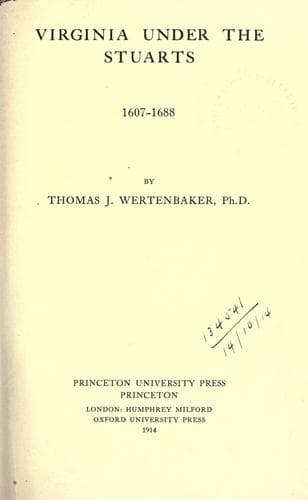
Virginia under the Stuarts 1607-1688Wertenbaker, Thomas Jefferson
History
Virginia under the Stuarts 1607-1688
Wertenbaker, Thomas Jefferson
Virginia -- History -- Colonial period, ca. 1600-1775
cannot more gloriously sacrifice then for my loyalty, and your
security."[351]
When the Governor had completed his appeal the obnoxious act of
Parliament was read aloud. The Assembly then passed a series of
resolutions, reiterating their loyalty to the Crown, denouncing the
Commons as usurpers and regicides, and defending themselves against the
charge of treachery and rebellion. They had, they declared, adhered
always to the "Lawes of England", which enjoined upon them the oaths of
allegiance and supremacy, and they refused now, at the bidding of
Parliament, to break their word by renouncing their King. They could not
be expected to give passive obedience to every party that possessed
themselves of Westminster Hall, where the heads of divers factions had
followed each other in quick succession. They had been accused of
usurping the government of the colony, but their records would show that
they had never swerved from their allegiance. And it ill became the
Parliament that had overthrown the English constitution to bring such
accusations. Finally, they declared, "we are resolv'd to Continue our
Allegeance to our most Gratious King, yea as long as his gratious favour
permits us, we will peaceably trade with the Londoners, and all other
nations in amity with our Soveraigne: Protect all forraigne Merchants
with our utmost force in our Capes: Allwaies pray for the happy
restoration of our King, and repentance in them, who to the hazard of
their soules have opposed him."[352]
As Berkeley had foreseen, the English found it impossible to enforce a
strict blockade. The government could not spare war vessels enough to
close the Virginia capes, and foreign merchantmen continued to sail
unmolested into the James and the York, bringing goods to the planters
and taking off their tobacco. Indeed the Dutch took advantage of this
quarrel between colony and mother country to extend their American
trade at the expense of the English merchants. The Council of State was
soon made to realize by the complaints that poured in from the London
shippers, that the "Blockade Act" was injuring England more than the
refractory colony.
At this moment, several leaders of the Virginia Parliamentary party came
to the Council at Westminster and represented to it the necessity of
fitting out an expedition to overthrow the Berkeley government. They
could plead that the blockade had proved ineffective, that the honor of
the Commonwealth demanded the prompt subjection of the impudent
Governor, that the coöperation of the Virginia commons would make the
task easy. Nor could they omit to remind the Councillors that it was
their duty to bring relief to their fellow Puritans of Virginia.
Public-domain text, read in full here on John Shaqi.
Reviews
Reviews
No reviews yet
Be the first to share your thoughts on this work.
Elsewhere in the archive
Join the Discussion
Join the discussion
Sign in to leave a comment or review.
Sign InorCreate an account