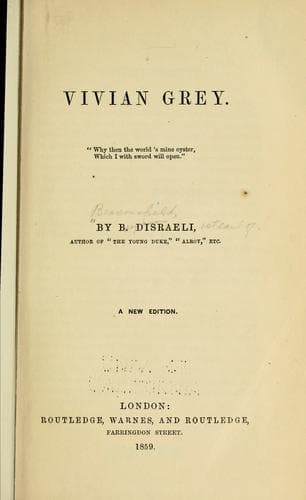
Vivian GreyDisraeli, Benjamin, Earl of Beaconsfield
ReligionIslamic
Vivian Grey
Disraeli, Benjamin, Earl of Beaconsfield
Bildungsromans; British -- Europe -- Fiction; Political fiction; Politicians -- Fiction; Young men -- Fiction
“But,” continued the Baron, “these clumsy burghers, with their affected
enthusiasm, as you well observe; who could have contemplated such
novices in diplomacy! Whatever may be the issue, I can at least lay my
head upon my pillow and feel that I have done my duty. Did not I, de
Boeffleurs, first place the negotiation on a basis of acknowledged
feasibility and mutual benefit? Who drew the protocol, I should like to
know? Who baffled the intrigues of the English Minister, the Lord
Amelius Fitzfudge Boroughby? Who sat up one whole night with the
Signora’s friend, the Russian Envoy, Baron Squallonoff, and who was it
that first arranged about the extra chariot?” and here the
representative of a first-rate German Power looked very much like a
resigned patriot, who feels that he deserves a ribbon.
“No doubt of it, my dear Von Konigstein,” echoed the French Chargé
d’Affaires, “and I think, whatever may be the result, that I, too, may
look back to this negotiation with no ungratified feelings. Had the
arrangement been left as I had wished, merely to the Ministers of the
Great Powers, I am confident that the Signora would have been singing
this night in our Opera House.”
“What is the grand point of difference at present?” asked the Austrian.
“A terrific one,” said the Baron; “the lady demanded twenty covers, two
tables, two carriages, one of which I arranged should be a chariot; that
at least the town owes to me; and, what else? merely a town mansion and
establishment. Exerting myself day and night, these terms were at length
agreed to by the municipality, and the lady was to ride over from
Darmstadt to sign and seal. In the course of her ride she took a cursed
fancy to the country villa of a great Jew banker, and since that moment
the arrangement has gone off. We have offered her everything; the
commandant’s country castle; his lady’s country farm; the villa of the
director of the Opera; the retreat of our present prima donna; all in
vain. We have even hinted at a temporary repose in a neighbouring royal
residence; but all useless. The banker and the Signora are equally
intractable, and Frankfort is in despair.”
“She ought to have signed and sealed at Darmstadt,” said the Count, very
indignantly.
“To be sure! they should have closed upon her caprice, and taken her
when she was in the fancy.”
“Talking of Opera girls,” commenced the Polish Prince, “I remember the
Countess Katszinski--”
“Your Highness has nothing upon your plate,” quickly retorted the Baron,
who was in no humour for a story.
“Nothing more, I thank you,” continued the Prince: “as I was saying, I
remember the Countess Katszinski--” but just at this moment the door
opened, and Ernstorff entered and handed a despatch to the Baron,
recommending it to his Excellency’s particular attention.
“Business, I suppose,” said the Plenipotentiary; “it may wait till
to-morrow.”
“From M. Clarionet, your Excellency.”
Public-domain text, read in full here on John Shaqi.
Reviews
Reviews
No reviews yet
Be the first to share your thoughts on this work.
Elsewhere in the archive
Join the Discussion
Join the discussion
Sign in to leave a comment or review.
Sign InorCreate an account