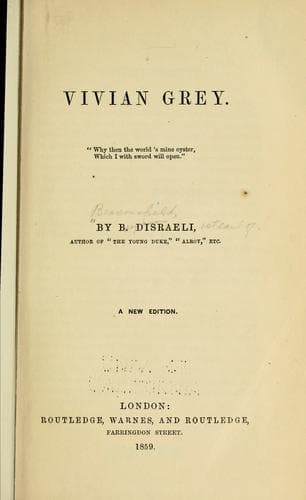
Vivian GreyDisraeli, Benjamin, Earl of Beaconsfield
ReligionIslamic
Vivian Grey
Disraeli, Benjamin, Earl of Beaconsfield
Bildungsromans; British -- Europe -- Fiction; Political fiction; Politicians -- Fiction; Young men -- Fiction
“An Englishman, I believe?” said the Colonel, bowing. He was a starch
militaire, with a blue frock coat buttoned up to his chin, a bald head
with a few grey hairs, and long, thin mustachios like a mandarin’s. “An
Englishman, I believe; pray, sir, will you inform me whether the
household troops in England wear the Marboeuf cuirass?”
“Sir!” said Vivian.
“I esteem myself particularly fortunate in thus meeting with an English
gentleman. It was only at dinner to-day that a controversy arose between
Major von Musquetoon and the Prince of Buttonstein on this point. As I
said to the Prince, you may argue for ever, for at present we cannot
decide the fact. How little did I think when I parted from the Major
that in a few minutes I should be able to settle the question beyond a
doubt. I esteem myself particularly fortunate in meeting with an
Englishman.”
“I regret to say, Colonel, that the question is one that I cannot
decide.”
“Sir, I wish you good morning,” said the Colonel, very drily; and,
staring keenly at Vivian, he walked away.
“He is good enough to fight, I suppose,” said the Baron, with a smile
and shrug of the shoulders, which seemed to return thanks to Providence
for having been educated in the civil service.
At this moment Lady Madeleine Trevor, leaning on the arm of the same
gentleman, passed, and the Baron bowed. The bow was coldly returned.
“You know her Ladyship, then! well!”
“I did know her,” said the Baron; “but I see from her bow that I am at
present in no very high favour. The truth is, she is a charming woman,
but I never expected to see her in Germany, and there was some little
commission of hers which I neglected, some little order for Eau de
Cologne, or a message about a worked pocket-handkerchief, which I
utterly forgot: and then, I never wrote! and you know. Grey, that these
little sins of omission are never forgiven by women.”
“My dear friend, De Konigstein, one pinch! one pinch!” chirped out a
little old odd-looking man, with a poudré head, and dressed in a costume
in which the glories of the vieille cour seemed to retire with
reluctance. A diamond ring twinkled on the snuffy hand, which was
encircled by a rich ruffle of dirty lace. The brown coat was not
modern, and yet not quite such an one as was worn by its master when he
went to see the King dine in public at Versailles before the Revolution:
large silver buckles still adorned the well-polished shoes; and silk
stockings, whose hue was originally black, were picked out with
clock-work of gold.
“My dear Marquis, I am most happy to see you; will you try the
boulangero?”
“With pleasure! A-a-h! what a box! a Louis-Quatorze, I think?”
“Oh, no! by no means so old.”
“Pardon me, my dear De Konigstein; I think a Louis-Quatorze.”
“I bought it in Sicily.”
“A-a-h!” slowly exclaimed the little man, shaking his head.
“Well, good afternoon,” said the Baron, passing on.
“My dear De Konigstein, one pinch; you have often said you have a
particular regard for me.”
Public-domain text, read in full here on John Shaqi.
Reviews
Reviews
No reviews yet
Be the first to share your thoughts on this work.
Elsewhere in the archive
Join the Discussion
Join the discussion
Sign in to leave a comment or review.
Sign InorCreate an account