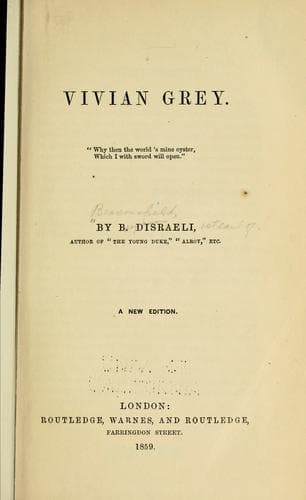
Vivian GreyDisraeli, Benjamin, Earl of Beaconsfield
ReligionIslamic
Vivian Grey
Disraeli, Benjamin, Earl of Beaconsfield
Bildungsromans; British -- Europe -- Fiction; Political fiction; Politicians -- Fiction; Young men -- Fiction
“There goes the most delightful woman in the world,” said the Baron;
“how fortunate that you know her! for really, as you might have
observed, I have no great claims on her indulgent notice. I was
certainly very wild in England; but then young men, you know, Grey! and
I did not leave a card, or call, before I went; and the English are
very stiff and precise about those things; and the Trevors had been very
kind to me. I think we had better take a little coffee now; and then, if
you like, we will just stroll into the REDOUTE.”
In a brilliantly-illuminated saloon, adorned with Corinthian columns and
casts from some of the most famous antique statues, assembled, between
nine and ten o’clock in the evening, many of the visitors at Ems. On
each side of the room was placed a long narrow table, one of which was
covered with green baize, and unattended; while the variously-coloured
leathern surface of the other was closely surrounded by an interested
crowd. Behind this table stood two individuals of different appearance.
The first was a short, thick man, whose only business was dealing
certain portions of playing cards with quick succession one after the
other: and as the fate of the table was decided by this process, did his
companion, a very tall, thin man, throw various pieces of money upon
certain stakes, which were deposited by the bystanders on different
parts of the table; or, which was much oftener the case, with a silver
rake with a long ebony handle, sweep into a large inclosure near him the
scattered sums. This inclosure was called the Bank, and the mysterious
ceremony in which these persons were assisting was the celebrated game
of rouge-et-noir. A deep silence was strictly preserved by those who
immediately surrounded the table; no voice was heard save that of the
little, short, stout dealer, when, without an expression of the least
interest, he seemed mechanically to announce the fate of the different
colours. No other sound was heard, except the jingle of the dollars and
Napoleons, and the ominous rake of the tall, thin banker. The
countenances of those who were hazarding their money were grave and
gloomy: their eyes were fixed, their brows contracted, and their lips
projected; and yet there was an evident effort visible to show that they
were both easy and unconcerned. Each player held in his hand a small
piece of pasteboard, on which, with a steel pricker, he marked, the run
of the cards, in order, from his observations, to regulate his own play.
The rouge-et-noir player imagines that chance is not capricious. Those
who were not interested in the game promenaded in two lines within the
tables, or, seated in recesses between the pillars, formed small parties
for conversation.
“I suppose we must throw away a dollar or two,” said the Baron, as he
walked up to the table.
“My dear De Konigstein, one pinch!”
“Ah! Marquess, what fortune to-night?”
Public-domain text, read in full here on John Shaqi.
Reviews
Reviews
No reviews yet
Be the first to share your thoughts on this work.
Elsewhere in the archive
Join the Discussion
Join the discussion
Sign in to leave a comment or review.
Sign InorCreate an account