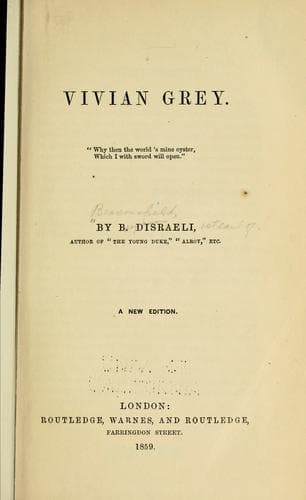
Vivian GreyDisraeli, Benjamin, Earl of Beaconsfield
ReligionIslamic
Vivian Grey
Disraeli, Benjamin, Earl of Beaconsfield
Bildungsromans; British -- Europe -- Fiction; Political fiction; Politicians -- Fiction; Young men -- Fiction
“The violent death of a woman, young, lovely, and innocent, is assuredly
the most terrible of tragedies,” observed Vivian.
“I have often asked myself,” said Miss Fane, “which is the most terrible
destiny for the young to endure: to meet death after a life of anxiety
and suffering, or suddenly to be cut off in the enjoyment of all things
that make life delightful.”
“For my part,” said Vivian, “in the last instance, I think that death
can scarcely be considered an evil. How infinitely is such a destiny to
be preferred to that long apprenticeship of sorrow, at the end of which
we are generally as unwilling to die as at the commencement!”
“And yet,” said Miss Fane, “there is something fearful in the idea of
sudden death.”
“Very fearful,” muttered Vivian, “in some cases;” for he thought of one
whom he had sent to his great account before his time.
“Violet, my dear!” said Lady Madeleine, “have you finished your drawing
of the Bingenloch?” But Miss Fane would not leave the subject.
“Very fearful in all cases, Mr. Grey. How few of us are prepared to
leave this world without warning! And if from youth, or sex, or natural
disposition, a few may chance to be better fitted for the great change
than their companions, still I always think that in those cases in which
we view our fellow-creatures suddenly departing from this world,
apparently without a bodily or mental pang, there must be a moment of
suffering which none of us can understand; a terrible consciousness of
meeting death in the very flush of life; a moment of suffering which,
from its intense and novel character, may appear an eternity of anguish.
I have always looked upon such an end as the most fearful of
dispensations.”
“Violet, my dear.” said her Ladyship, “let us talk no more of death. You
have been silent a fortnight. I think to-night you may sing.” Miss Fane
rose and sat down to the instrument.
It was a lively air, calculated to drive away all melancholy feelings,
and cherishing sunny views of human life. But Rossini’s Muse did not
smile to-night upon her who invoked its gay spirit; and ere Lady
Madeleine could interfere Violet Fane had found more congenial emotions
in one of Weber’s prophetic symphonies.
O Music! miraculous art, that makes a poet’s skill a jest, revealing to
the soul inexpressible feelings by the aid of inexplicable sounds! A
blast of thy trumpet, and millions rush forward to die; a peal of thy
organ, and uncounted nations sink down to pray. Mighty is thy
threefold power!
First, thou canst call up all elemental sounds, and scenes, and
subjects, with the definiteness of reality. Strike the lyre! Lo! the
voice of the winds, the flash of the lightning, the swell of the wave,
the solitude of the valley!
Then thou canst speak to the secrets of a man’s heart as if by
inspiration. Strike the lyre! Lo! our early love, our treasured hate,
our withered joy, our flattering hope!
Public-domain text, read in full here on John Shaqi.
Reviews
Reviews
No reviews yet
Be the first to share your thoughts on this work.
Elsewhere in the archive
Join the Discussion
Join the discussion
Sign in to leave a comment or review.
Sign InorCreate an account