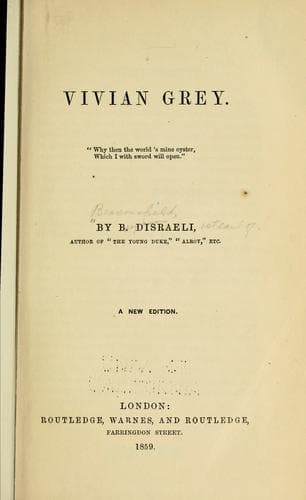
Vivian GreyDisraeli, Benjamin, Earl of Beaconsfield
ReligionIslamic
Vivian Grey
Disraeli, Benjamin, Earl of Beaconsfield
Bildungsromans; British -- Europe -- Fiction; Political fiction; Politicians -- Fiction; Young men -- Fiction
“My brother,” said Lady Madeleine, “is a very good young man, with a
kind heart and warm feelings; but my brother has not much knowledge of
the world, and he is too honourable himself ever to believe that what he
calls a gentleman can be dishonest. My brother was not in England when
the unhappy event took place, and of course the various circumstances
have not made the same impression upon him as upon us. He has heard of
the affair only from me; and young men too often imagine that women are
apt to exaggerate in matters of this nature, which, of course, few of us
can understand. The Baron had not the good feeling, or perhaps had not
the power, connected as he was with the Grand Duke, to affect ignorance
of our former acquaintance, or to avoid a second one. I was obliged
formally to present him to my brother. I was quite perplexed how to act.
I thought of writing to him the next morning, impressing upon him the
utter impossibility of our acquaintance being renewed: but this
proceeding involved a thousand difficulties. How was a man of his
distinction, a man, who not only from his rank, but from his
disposition, is always a remarkable and a remarked character, wherever
he may be; how could he account to the Grand Duke, and to his numerous
friends, for his not associating with a party with whom he was
perpetually in contact. Explanations, and worse, must have been the
consequence. I could hardly expect him to leave Ems; it was, perhaps,
out of his power: and for Miss Fane to leave Ems at this moment was most
strenuously prohibited by her physician. While I was doubtful and
deliberating, the conduct of Baron von Konigstein himself prevented me
from taking any step whatever. Feeling all the awkwardness of his
situation, he seized, with eagerness, the opportunity of becoming
intimate with a member of the family whom he had not before known. His
amusing conversation, and insinuating address, immediately enlisted the
feelings of my brother in his favour. You know yourself that the very
morning after their introduction they were riding together. As they
became more intimate, the Baron boldly spoke to Albert, in confidence,
of his acquaintance with us in England, and of the unhappy circumstances
which led to its termination. Albert was deceived by this seeming
courage and candour. He has become the Baron’s friend, and has adopted
his version of the unhappy story; and as the Baron has had too much
delicacy to allude to the affair in a defence of himself to me, he
calculated that the representations of Albert, who, he was conscious,
would not preserve the confidence which he has always intended him to
betray, would assist in producing in my mind an impression in his
favour. The Neapolitan story which he told the other day at dinner was
of himself. I confess to you, that though I have not for a moment
doubted his guilt, still I was weak enough to consider that his desire
to become reconciled to me was at least an evidence of a repentant
Public-domain text, read in full here on John Shaqi.
Reviews
Reviews
No reviews yet
Be the first to share your thoughts on this work.
Elsewhere in the archive
Join the Discussion
Join the discussion
Sign in to leave a comment or review.
Sign InorCreate an account