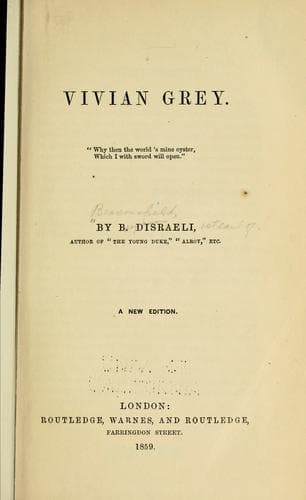
Vivian GreyDisraeli, Benjamin, Earl of Beaconsfield
ReligionIslamic
Vivian Grey
Disraeli, Benjamin, Earl of Beaconsfield
Bildungsromans; British -- Europe -- Fiction; Political fiction; Politicians -- Fiction; Young men -- Fiction
The reader will remember that Vivian had agreed to dine, on the day
after the fête, with the Baron, in his private apartments. This was an
arrangement which, in fact, the custom of the house did not permit; but
the irregularities of great men who are attended by chasseurs are
occasionally winked at by a supple maître d’hôtel. Vivian had reasons
for not regretting his acceptance of the invitation; and he never shook
hands with the Chevalier de Boeffleurs, apparently, with greater
cordiality, than on the day on which he met him at dinner at the Baron
von Konigstein’s. Mr. St. George had not arrived.
“Past five!” said the Baron; “riding out, I suppose, with the Fitzlooms.
Aurelia is certainly a fine girl; but I should think that Lady Madeleine
would hardly approve the connection. The St. Georges have blood in their
veins; and would, I suppose, as soon think of marrying a Fitzloom as we
Germans should of marrying a woman without a _von_ before her name. We
are quite alone, Grey, only the Chevalier and St. George. I had an idea
of asking Salvinski, but he is such a regular steam-engine, and began
such a long story last night about his interview with the King of
Ashantee, that the bare possibility of his taking it into his head to
finish it to-day frightened me. You were away early from the Grand
Duke’s last night. The business went off well.”
“Very well, indeed!” said the Chevalier de Boeffleurs; completing by
this speech the first dozen of words which he had uttered since his
stay at Ems.
“I think that last night Lady Madeleine Trevor looked perfectly
magnificent; and a certain lady, too, Grey, eh? Here is St. George. My
dear fellow, how are you? Has the fair Aurelia recovered from the last
night’s fatigues? Now, Ernstorff, dinner as soon as possible.”
The Baron made up to-day, certainly, for the silence of his friend the
Chevalier. He outdid himself. Story after story, adventure after
adventure, followed each other with exciting haste. In fact, the Baron
never ceased talking the whole dinner, except when he refreshed himself
with wine, which he drank copiously. A nice observer would, perhaps,
have considered the Baron’s high spirits artificial, and his
conversation an effort. Yet his temper, though lively, was generally
equable; and his ideas, which always appeared to occur easily, were
usually thrown out in fluent phraseology. The dinner was long, and a
great deal of wine was drunk: more than most of the parties present for
a long time had been accustomed to. About eight o’clock the Chevalier
proposed going to the Redoute, but the Baron objected.
“Let us have an evening altogether: surely we have had enough of the
Redoute. In my opinion one of the advantages of the fête is, that there
is no New House to-night. Conversation is a novelty. On a moderate
calculation I must have told you to-day at least fifty original
anecdotes. I have done my duty. It is the Chevalier’s turn now. Come, de
Boeffleurs, a choice one!”
Public-domain text, read in full here on John Shaqi.
Reviews
Reviews
No reviews yet
Be the first to share your thoughts on this work.
Elsewhere in the archive
Join the Discussion
Join the discussion
Sign in to leave a comment or review.
Sign InorCreate an account