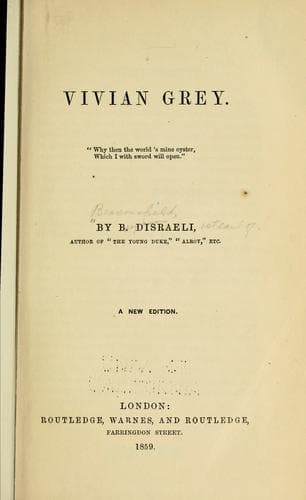
Vivian GreyDisraeli, Benjamin, Earl of Beaconsfield
ReligionIslamic
Vivian Grey
Disraeli, Benjamin, Earl of Beaconsfield
Bildungsromans; British -- Europe -- Fiction; Political fiction; Politicians -- Fiction; Young men -- Fiction
And Vivian and his beautiful companion owned the magic of this hour, as
all must do, by silence. No word was spoken, yet is silence sometimes a
language. They gazed, and gazed again, and their full spirits held due
communion with the starlit sky, and the mountains and the woods, and the
soft shadows of the increasing moon. Oh! who can describe what the
o’ercharged spirit feels at this sacred hour, when we almost lose the
consciousness of existence, and our souls seem to struggle to pierce
futurity! In the forest of the mysterious Odenwald, in the solitudes of
the Bergstrasse, had Vivian at this hour often found consolation for a
bruised spirit, often in adoring nature had forgotten man. But now, when
he had never felt nature’s influence more powerful; when he had never
forgotten man and man’s world more thoroughly; when he was experiencing
emotions, which, though undefinable, he felt to be new; he started when
he remembered that all this was in the presence of a human being! Was it
Hesperus he gazed upon, or something else that glanced brighter than an
Evening star? Even as he thought that his gaze was fixed on the
countenance of nature, he found that his eyes rested on the face of
nature’s loveliest daughter!
“Violet! dearest Violet!”
As in some delicious dream the sleeper is awakened from his bliss by the
sound of his own rapturous voice, so was Vivian roused by these words
from his reverie, and called back to the world which he had forgotten.
But ere a moment had passed, he was pouring forth in a rapid voice, and
incoherent manner, such words as men speak only once. He spoke of his
early follies, his misfortunes, his misery; of his matured views, his
settled principles, his plans, his prospects, his hopes, his happiness,
his bliss; and when he had ceased, he listened, in his turn, to some
small still words, which made him the happiest of human beings. He bent
down, he kissed the soft silken cheek which now he could call his own.
Her hand was in his; her head sank upon his breast. Suddenly she clung
to him with a strong grasp. “Violet! my own, my dearest; you are
overcome. I have been rash, I have been imprudent. Speak, speak, my
beloved! say, you are not ill!”
She spoke not, but clung to him with a fearful strength, her head still
upon his breast, her full eyes closed. Alarmed, he raised her off the
ground, and bore her to the river-side. Water might revive her. But when
he tried to lay her a moment on the bank, she clung to him gasping, as a
sinking person clings to a stout swimmer. He leant over her; he did not
attempt to disengage her arms; and, by degrees, by very slow degrees,
her grasp loosened. At last her arms gave way and fell by his side, and
her eyes partly opened.
“Thank God! Violet, my own, my beloved, say you are better!”
Public-domain text, read in full here on John Shaqi.
Reviews
Reviews
No reviews yet
Be the first to share your thoughts on this work.
Elsewhere in the archive
Join the Discussion
Join the discussion
Sign in to leave a comment or review.
Sign InorCreate an account