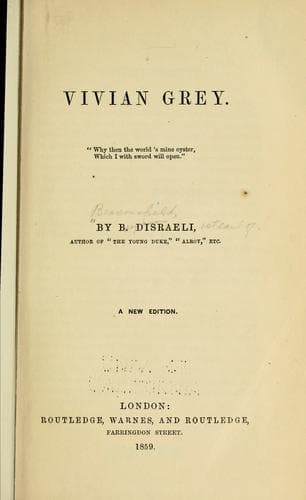
Vivian GreyDisraeli, Benjamin, Earl of Beaconsfield
ReligionIslamic
Vivian Grey
Disraeli, Benjamin, Earl of Beaconsfield
Bildungsromans; British -- Europe -- Fiction; Political fiction; Politicians -- Fiction; Young men -- Fiction
The porter led them into a room, at a round table in which about
half-a-dozen individuals were busily engaged in discussing the merits of
various agreeable liquors. There was an attempt to get up a show of
polite hospitality to Vivian as he entered, but the man who offered him
his chair fell to the ground in an unsuccessful struggle to be
courteous; and another one, who had filled a large glass for the guest
on his entrance, offered him, after a preliminary speech of incoherent
compliments, the empty bottle by mistake. The porter and his friends,
although they were all drunk, had sense enough to feel that the presence
of a Prince of the Holy Roman Empire, a Chevalier of the Golden Fleece,
and the particular friend of their master, was not exactly a fit
companion for themselves, and was rather a check on the gay freedom of
equal companionship; and so, although the exertion was not a little
troublesome, the guardian of the gate reeled out of the room to inform
his honoured lord of the sudden arrival of a stranger of distinction,
Essper George immediately took his place, and ere the master of the
lodge had returned the noble secretary had not only given a choice
toast, sung a choice song, and been hailed by the grateful plaudits of
all present, but had proceeded in his attempt to fulfil the pledge which
he had given at the gate to the very letter by calling out lustily for a
bottle of Geisenheim, lemons, brandy, and a bowl.
“Fairly and softly, my little son of Bacchus,” said the porter as he
re-entered, “fairly and softly, and then thou shalt want nothing; but
remember I have to perform my duties unto the noble Lord my master, and
also to the noble Prince your master. If thou wilt follow me,” continued
the porter, reeling as he bowed with the greatest consideration to
Vivian; “if thou wilt follow me, most high and mighty sir, my master
will be right glad to have the honour of drinking your health. And as
for you, my friends, fairly and softly say I again. We will talk of the
Geisenheim anon. Am I to be absent from the first brewing? No, no!
fairly and softly; you can drink my health when I am absent in cold
liquor, and say those things which you could not well say before my
face. But mind, my most righteous and well-beloved, I will have no
flattery. Flattery is the destruction of all good fellowship; it is like
a qualmish liqueur in the midst of a bottle of wine. Speak your minds,
say any little thing that comes first, as thus, ‘Well, for Hunsdrich,
the porter, I must declare that I never heard evil word against him;’ or
thus, ‘A very good leg has Hunsdrich the porter, and a tight-made lad
altogether; no enemy with the girls, I warrant me;’ or thus, ‘Well, for
a good-hearted, good-looking, stout-drinking, virtuous, honourable,
handsome, generous, sharp-witted knave, commend me to Hunsdrich the
porter;’ but not a word more, my friends, not a word more, no
flattery--Now, sir, I beg your pardon.”
Public-domain text, read in full here on John Shaqi.
Reviews
Reviews
No reviews yet
Be the first to share your thoughts on this work.
Elsewhere in the archive
Join the Discussion
Join the discussion
Sign in to leave a comment or review.
Sign InorCreate an account