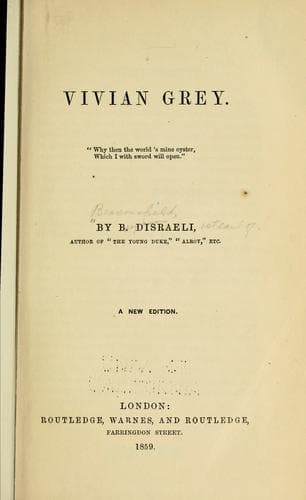
Vivian GreyDisraeli, Benjamin, Earl of Beaconsfield
ReligionIslamic
Vivian Grey
Disraeli, Benjamin, Earl of Beaconsfield
Bildungsromans; British -- Europe -- Fiction; Political fiction; Politicians -- Fiction; Young men -- Fiction
“Silence, my Lords!” said the Grand Duke. “Forget we that ignorance is
the stranger’s portion, and that no treason can exist among those who
are not our sworn subjects? Pity we rather the degeneracy of this
bold-spoken youth, and in the plenitude of our mercy let us pardon his
demand! Know ye, unknown knight, that you are in the presence of an
august society who are here met at one of their accustomed convocations,
whereof the purport is the frequent quaffing of those most glorious
liquors of which the sacred Rhine is the great father. We profess to
find a perfect commentary on the Pindaric laud of the strongest element
in the circumstance of the banks of a river being the locality where the
juice of the grape is most delicious, and holding, therefore, that water
is strongest because, in a manner, it giveth birth to wine, we also hold
it as a sacred element, and consequently most religiously refrain from
refreshing our bodies with that sanctified and most undrinkable fluid.
Know ye that we are the children of the Rhine, the conservators of his
flavours, profound in the learning of his exquisite aroma, and deep
students in the mysteries of his inexplicable näre. Professing not to be
immortal, we find in the exercise of the chase a noble means to preserve
that health which is necessary for the performance of the ceremonies to
which we are pledged. At to-morrow’s dawn our bugle sounds, and thou,
stranger, may engage the wild boar at our side; at to-morrow’s noon the
castle bell will toll, and thou, stranger, may eat of the beast which
thou hast conquered; but to feed after midnight, to destroy the power of
catching the delicate flavour, to annihilate the faculty of detecting
the undefinable näre, is heresy, most rank and damnable heresy!
Therefore at this hour soundeth no plate or platter, jingleth no knife
or culinary instrument, in the PALACE OF THE WINES. Yet, in
consideration of thy youth, and that on the whole thou hast tasted thy
liquor like a proper man, from which we augur the best expectations of
the manner in which thou wilt drink it, we feel confident that our
brothers of the goblet will permit us to grant thee the substantial
solace of a single shoeing horn.”
“Let it be a Dutch herring, then,” said Vivian, “and as you have souls
to be saved grant me one slice of bread.”
“It cannot be,” said the Grand Duke; “but as we are willing to be
indulgent to bold hearts, verily, we will wink at the profanation of a
single toast; but you must order an anchovy one, and give secret
instructions to the waiting-man to forget the fish. It must be counted
as a second shoeing horn, and you will forfeit for the last a bottle of
Markbrunnen.”
“And now, illustrious brothers,” continued the Grand Duke, “let us drink
1726.”
All present gave a single cheer, in which Vivian was obliged to join,
and they honoured with a glass of the very year the memory of a
celebrated vintage.
“1748!” said the Grand Duke.
Two cheers and the same ceremony.
Public-domain text, read in full here on John Shaqi.
Reviews
Reviews
No reviews yet
Be the first to share your thoughts on this work.
Elsewhere in the archive
Join the Discussion
Join the discussion
Sign in to leave a comment or review.
Sign InorCreate an account