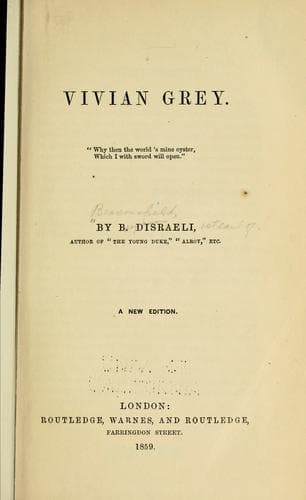
Vivian GreyDisraeli, Benjamin, Earl of Beaconsfield
ReligionIslamic
Vivian Grey
Disraeli, Benjamin, Earl of Beaconsfield
Bildungsromans; British -- Europe -- Fiction; Political fiction; Politicians -- Fiction; Young men -- Fiction
“Indifferently good, your Highness: your Highness forgets that the
animal was already exhausted by your assault.”
“Why, there is something in that; but it was neatly done, man; it was
neatly done. You are fond of the sport, we think?”
“I have had some practice, but illness has so weakened me that I have
given up the forest.”
“Pity! and on a second examination we observe that you are no hunter.
This coat is not for the free forest; but how came you by the pike?”
“I am travelling to the next post town, to which I have sent on my
luggage. I am getting fast to the south; and as for this pike, my
servant got it this morning from some peasant in a brawl, and was
showing it to me when I heard your Highness call. I really think now
that Providence must have sent it. I certainly could not have done you
much service with my riding whip. Hilloa! Essper, where are you?”
“Here, noble sir! here, here. Why, what have you got there? The horses
have jibbed, and will not stir. I can stay no longer: they may go to the
devil!” So saying, Vivian’s valet dashed over the underwood, and leaped
at the foot of the Prince.
“In God’s name, is this thy servant?” asked his Highness.
“In good faith am I,” said Essper; “his valet, his cook, and his
secretary, all in one; and also his Jagd Junker, or Gentilhomme de la
Chasse, as a puppy with a bugle horn told me this morning.”
“A merry knave!” said the Prince; “and talking of a puppy with a bugle
horn reminds us how unaccountably we have been deserted to-day by a
suite that never yet were wanting. We are indeed astonished. Our bugle,
we fear, has turned traitor.” So saying, the Prince executed a blast
with great skill, which Vivian immediately recognised as the one which
Essper George had imitated.
“And now, my good friend,” said the Prince, “we cannot hear of your
passing through our land without visiting our good castle. We would that
we could better testify the obligation that we feel under to you in any
other way than by the offer of an hospitality which all gentlemen, by
right, can command. But your presence would, indeed, give us sincere
pleasure. You must not refuse us. Your looks, as well as your prowess,
prove your blood; and we are quite sure no cloth-merchant’s order will
suffer by your not hurrying to your proposed point of destination. We
are not wrong, we think, though your accent is good, in supposing that
we are conversing with an English gentleman. But here they come.”
As he spoke, three or four horsemen, at the head of whom was the young
huntsman whom the travellers had met in the morning, sprang into
the glade.
“Why, Arnelm!” said the Prince, “when before was the Jagd Junker’s ear
so bad that he could not discover his master’s bugle, even though the
wind were against him?”
Public-domain text, read in full here on John Shaqi.
Reviews
Reviews
No reviews yet
Be the first to share your thoughts on this work.
Elsewhere in the archive
Join the Discussion
Join the discussion
Sign in to leave a comment or review.
Sign InorCreate an account