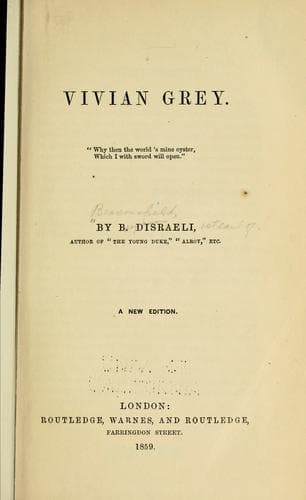
Vivian GreyDisraeli, Benjamin, Earl of Beaconsfield
ReligionIslamic
Vivian Grey
Disraeli, Benjamin, Earl of Beaconsfield
Bildungsromans; British -- Europe -- Fiction; Political fiction; Politicians -- Fiction; Young men -- Fiction
“My darling!” said the father, forgetting at this moment of genuine
feeling the pompous plural in which he had hitherto spoken of himself.
The Prince fondly kissed his child. The boy was about ten years of age,
exquisitely handsome. Courage, not audacity, was imprinted on his
noble features.
“Papa! may I hunt with you to-morrow?”
“What says Mr. Sievers?”
“Oh! Mr. Sievers says I am excellent; I assure you, upon my honour, he
does, I heard you come home; but though I was dying to see you, I would
not run out till I had finished my Roman History. I say, papa! what a
grand fellow Brutus was; what a grand thing it is to be a patriot! I
intend to be a patriot myself, and to kill the Grand Duke of Reisenburg.
Who is that?”
“My friend, Max, Mr. Grey. Speak to him.”
“I am happy to see you at Turriparva, sir,” said the boy, bowing to
Vivian with dignity. “Have you been hunting with his Highness
this morning?”
“I can hardly say I have.”
“Max, I have received a slight wound to-day. Do not look alarmed; it is
slight. I only mention it because, had it not been for this gentleman,
it is very probable you would never have seen your father again. He has
saved my life!”
“Saved your life! saved my papa’s life!” said the young Prince, seizing
Vivian’s hand. “Oh! sir, what can I do for you? Mr. Sievers!” said the
boy, with eagerness, to a gentleman who entered the room; “Mr. Sievers!
here is a young lord who has saved papa’s life!”
Mr. Sievers was a tall, thin man, about forty, with a clear sallow
complexion, a high forehead, on which a few wrinkles were visible,
bright keen eyes, and a quantity of grey curling hair, which was combed
back off his forehead, and fell down over his shoulders. He was
introduced to Vivian as the Prince’s particular friend; and then he
listened, apparently with interest, to his Highness’ narrative of the
morning’s adventure, his danger, and his rescue. Young Maximilian never
took his large, dark-blue eyes off his father while he was speaking, and
when he had finished the boy rushed to Vivian and threw his arms round
his neck. Vivian was delighted with the affection of the child, who
whispered to him in a low voice, “I know what you are!”
“What, my young friend?”
“Ah! I know.”
“But tell me!”
“You thought I should not find out: you are a patriot!”
“I hope I am,” said Vivian; “but travelling in a foreign country is
hardly a proof of it. Perhaps you do not know that I am an Englishman.”
“An Englishman!” said the child, with an air of great disappointment. “I
thought you were a patriot! I am one. Do you know I will tell you a
secret. You must promise not to tell, though. Promise, upon your word!
Well, then,” said the urchin, whispering with great energy in Vivian’s
ear through his hollow fist, “I hate the Grand Duke of Reisenburg, and I
mean to stab him to the heart.” So saying, the little Prince grated his
teeth with an expression of bitter detestation.
Public-domain text, read in full here on John Shaqi.
Reviews
Reviews
No reviews yet
Be the first to share your thoughts on this work.
Elsewhere in the archive
Join the Discussion
Join the discussion
Sign in to leave a comment or review.
Sign InorCreate an account