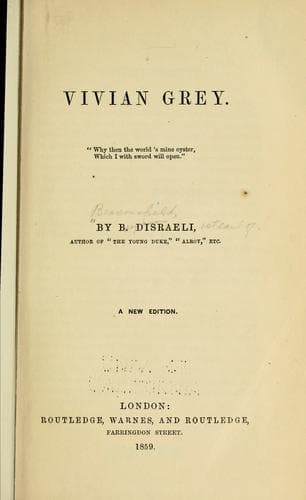
Vivian GreyDisraeli, Benjamin, Earl of Beaconsfield
ReligionIslamic
Vivian Grey
Disraeli, Benjamin, Earl of Beaconsfield
Bildungsromans; British -- Europe -- Fiction; Political fiction; Politicians -- Fiction; Young men -- Fiction
“He echoes the foolish zeal of my fond followers,” said the Prince, as
his son left the room. “The idle parade to which their illegal loyalty
still clings; my own manners, the relics of former days; habits will not
change like stations; all these have deceived you, sir. You have
mistaken me for a monarch; I should be one. A curse light on me the
hour I can mention it without a burning blush. Oh, shame! shame on the
blood of my father’s son! Can my mouth own that I once was one? Yes,
sir! you see before you the most injured, the least enviable of human
beings. I am a mediatised Prince!”
Vivian had resided too long in Germany to be ignorant of the meaning of
this title, with which, perhaps, few of our readers may be acquainted. A
mediatised Prince is an unhappy victim of those Congresses which, among
other good and evil, purged with great effect the ancient German
political system. By the regulations then determined on, that country
was freed at one fell swoop from the vexatious and harassing dominion of
the various petty Princes who exercised absolute sovereignties over
little nations of fifty thousand souls. These independent sovereigns
became subjects; and either swelled, by their mediatisation, the
territories of some already powerful potentate, or transmuted into a
state of importance some more fortunate petty ruler than themselves,
whose independence, through the exertions of political intrigue or
family influence, had been preserved inviolate. In most instances, the
concurrence of these little rulers in their worldly degradation was
obtained by a lavish grant of official emoluments or increase of
territorial possessions; and the mediatised Prince, instead of being an
impoverished and uninfluential sovereign, became a wealthy and powerful
subject. But so dominant in the heart of man is the love of independent
dominion, that even with these temptations few of the petty princes
could have been induced to have parted with their cherished sceptres,
had they not been conscious that, in case of contumacy, the resolutions
of a Diet would have been enforced by the armies of an emperor. As it
is, few of them have yet given up the outward and visible signs of regal
sway. The throne is still preserved and the tiara still revered. They
seldom frequent the courts of their sovereigns, and scarcely condescend
to notice the attentions of their fellow nobility. Most of them expend
their increased revenues in maintaining the splendour of their little
courts at their ancient capitals, or in swelling the ranks of their
retainers at their solitary forest castles.
Public-domain text, read in full here on John Shaqi.
Reviews
Reviews
No reviews yet
Be the first to share your thoughts on this work.
Elsewhere in the archive
Join the Discussion
Join the discussion
Sign in to leave a comment or review.
Sign InorCreate an account