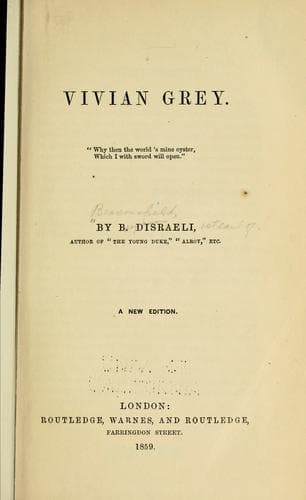
Vivian GreyDisraeli, Benjamin, Earl of Beaconsfield
ReligionIslamic
Vivian Grey
Disraeli, Benjamin, Earl of Beaconsfield
Bildungsromans; British -- Europe -- Fiction; Political fiction; Politicians -- Fiction; Young men -- Fiction
“My friend, you are a trusty messenger, and have been well trained.
Rodolph, look that this gentleman be well lodged and attended.”
“I thank your Highness,” said the messenger, “but I do not tarry here. I
wait no answer, and my only purpose in seeing you was to perform my
commission to the letter, by delivering this paper into your own hands.”
“As you please, sir; you must be the best judge of your own time; but we
like not strangers to leave our gates while our drawbridge is yet
echoing with their entrance steps.”
The Prince and Vivian were again alone. Astonishment and agitation were
visible on his Highness’ countenance as he threw his eye over the
letter. At length he folded it up, put it into his breast-pocket and
tried to resume conversation; but the effort was both evident and
unsuccessful. In another moment the letter was again taken out, and
again read with not less emotion than accompanied its first perusal.
“I fear I have wearied you, Mr. Grey,” said his Highness; “it was
inconsiderate in me not to remember that you require repose.”
Vivian was not sorry to have an opportunity of retiring, so he quickly
took the hint, and wished his Highness agreeable dreams.
CHAPTER IV
No one but an adventurous traveller can know the luxury of sleep. There
is not a greater fallacy in the world than the common creed that sweet
sleep is labour’s guerdon. Mere regular, corporeal labour may certainly
procure us a good, sound, refreshing slumber, disturbed often by the
consciousness of the monotonous duties of the morrow; but how sleep the
other great labourers of this laborious world? Where is the sweet sleep
of the politician? After hours of fatigue in his office and hours of
exhaustion in the House, he gains his pillow; and a brief, feverish
night, disturbed by the triumph of a cheer and the horrors of a reply.
Where is the sweet sleep of the poet? We all know how harassing are the
common dreams which are made up of incoherent images of our daily life,
in which the actors are individuals that we know, and whose conduct
generally appears to be regulated by principles which we can comprehend.
How much more enervating and destroying must be the slumber of that man
who dreams of an imaginary world! waking, with a heated and excited
spirit, to mourn over some impressive incident of the night, which is
nevertheless forgotten, or to collect some inexplicable plot which has
been revealed in sleep, and has fled from the memory as the eyelids have
opened. Where is the sweet sleep of the artist? of the lawyer? Where,
indeed, of any human being to whom to-morrow brings its necessary
duties? Sleep is the enemy of Care, and Care is the constant companion
of regular labour, mental or bodily.
Public-domain text, read in full here on John Shaqi.
Reviews
Reviews
No reviews yet
Be the first to share your thoughts on this work.
Elsewhere in the archive
Join the Discussion
Join the discussion
Sign in to leave a comment or review.
Sign InorCreate an account