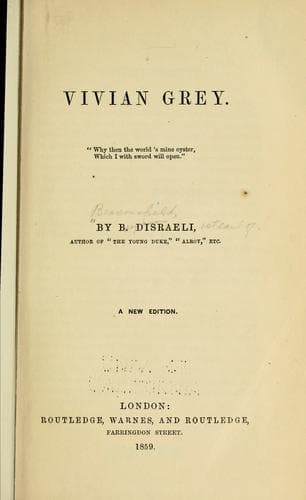
Vivian GreyDisraeli, Benjamin, Earl of Beaconsfield
ReligionIslamic
Vivian Grey
Disraeli, Benjamin, Earl of Beaconsfield
Bildungsromans; British -- Europe -- Fiction; Political fiction; Politicians -- Fiction; Young men -- Fiction
meditation: for the geologist is the most satisfactory of antiquarians,
the most interesting of philosophers, and the most inspired of prophets;
demonstrating that which has past by discovery, that which is occurring
by observation, and that which is to come by induction. When you go to
Vienna I will give you a letter to Frederic Schlegel; we were
fellow-students, and are friends, though for various reasons we do not
at present meet; nevertheless a letter from me will command respect. I
will recommend you, however, before you go on to Vienna, to visit
Reisenburg.”
“Indeed! from the Prince’s account, I should have thought that there was
little to interest me there.”
“His Highness is not an impartial judge. You are probably acquainted
with the disagreeable manner in which he is connected with that Court.
Far from his opinion being correct, I should say there are few places in
Germany more worthy of a visit than the little Court near us; and above
all things my advice is that you should not pass it over.”
“I am inclined to follow it. You are right in supposing that I am not
ignorant that His Highness has the misfortune of being a mediatised
Prince; but what is the exact story about him? I have heard some odd
rumours, some--”
“It is a curious story, but I am afraid you will find it rather long.
Nevertheless, if you really visit Reisenburg, it may be of use to you to
know something of the singular characters you will meet there. In the
first place, you say you know that Little Lilliput is a mediatised
Prince, and, of course, are precisely aware what that title means.
About fifty years ago, the rival of the illustrious family in whose
chief castle we are both of us now residing was the Margrave of
Reisenburg, another petty Prince with territories not so extensive as
those of our friend, and with a population more limited: perhaps fifty
thousand souls, half of whom were drunken cousins. The old Margrave of
Reisenburg, who then reigned, was a perfect specimen of the
old-fashioned German Prince: he did nothing but hunt and drink and think
of the quarterings of his immaculate shield, all duly acquired from some
Vandal ancestor as barbarous as himself. His little Margraviate was
misgoverned enough for a great empire. Half of his nation, who were his
real people, were always starving, and were unable to find crown pieces
to maintain the extravagant expenditure of the other moiety, the
cousins; who, out of gratitude to their fellow-subjects for their
generous support, harassed them with every species of excess. Complaints
were of course made to the Margrave, and loud cries for justice
resounded at the palace gates. This Prince was an impartial chief
magistrate; he prided himself upon his “invariable” principles of
justice, and he allowed nothing to influence his decisions. His plan for
arranging all differences had the merit of being brief; and if brevity
be the soul of wit, it certainly was most unreasonable in his subjects
Public-domain text, read in full here on John Shaqi.
Reviews
Reviews
No reviews yet
Be the first to share your thoughts on this work.
Elsewhere in the archive
Join the Discussion
Join the discussion
Sign in to leave a comment or review.
Sign InorCreate an account