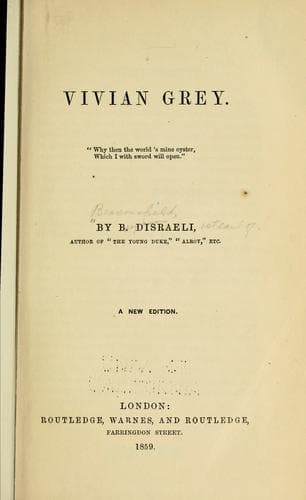
Vivian GreyDisraeli, Benjamin, Earl of Beaconsfield
ReligionIslamic
Vivian Grey
Disraeli, Benjamin, Earl of Beaconsfield
Bildungsromans; British -- Europe -- Fiction; Political fiction; Politicians -- Fiction; Young men -- Fiction
“By no means! The Grand Duke is a scholar; a man of refined taste, a
patron of the fine arts, a lover of literature, a promoter of science,
and what the world would call a philosopher. His judgment is sound, and
generally correct, his powers of discrimination acute, and his knowledge
of mankind greater than that of most sovereigns; but with all these
advantages he is cursed with such a wavering and indecisive temper, that
when, which is usually the case, he has come to a right conclusion, he
can never prevail upon himself to carry his theory into practice; and
with all his acuteness, his discernment, and his knowledge of the world,
his mind is always ready to receive any impression from the person who
last addresses him, though he himself be fully aware of the inferiority
of his adviser’s intellect to his own, or the imperfection of that
adviser’s knowledge. Never for a moment out of the sight of Beckendorff,
the royal pupil has made an admirable political puppet, since his
talents have always enabled him to understand the part which the
Minister had forced him to perform. Thus the world has given the Grand
Duke credit, not only for the possession of great talents, but almost
for as much firmness of mind and decision of character as his Minister.
But since his long-agitated career has become calm and tranquil, and
Beckendorff, like a guardian spirit, has ceased to be ever at his elbow,
the character of the Grand Duke of Reisenburg begins to be understood.
His Court has been, and still is, frequented by all the men of genius
in Germany, who are admitted without scruple, even if they be not noble.
But the astonishing thing is, that the Grand Duke is always surrounded
by every species of political and philosophical quack that you can
imagine. Discussions on a free press, on the reformation of the criminal
code, on the abolition of commercial duties, and such like interminable
topics, are perpetually resounding within the palace of this arbitrary
Prince; and the people, fired by the representations of the literary and
political journals with which Reisenburg abounds, and whose bold
speculations on all subjects elude the vigilance of the censor, by being
skilfully amalgamated with a lavish praise of the royal character, are
perpetually flattered with the speedy hope of becoming freemen.
Suddenly, when all are expecting the grant of a charter or the
institution of Chambers, Mr. Beckendorff rides up from his retreat to
the Residence, and the next day the whole crowd of philosophers are
swept from the royal presence, and the censorship of the press becomes
so severe, that for a moment you would fancy that Reisenburg, instead of
being, as it boasts itself, the modern Athens, had more right to the
title of the modern Boeotia. The people, who enjoy an impartial
administration of equal laws, who have flourished, and are flourishing,
under the wise and moderate rule of their new monarch, have in fact no
Public-domain text, read in full here on John Shaqi.
Reviews
Reviews
No reviews yet
Be the first to share your thoughts on this work.
Elsewhere in the archive
Join the Discussion
Join the discussion
Sign in to leave a comment or review.
Sign InorCreate an account