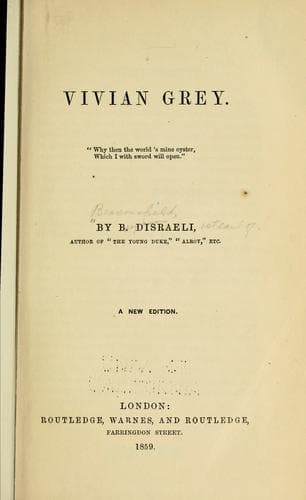
Vivian GreyDisraeli, Benjamin, Earl of Beaconsfield
ReligionIslamic
Vivian Grey
Disraeli, Benjamin, Earl of Beaconsfield
Bildungsromans; British -- Europe -- Fiction; Political fiction; Politicians -- Fiction; Young men -- Fiction
“Sievers, who is a man of considerable talents, was for a long time a
professor in one of our great Universities. The publication of many able
works procured him a reputation which induced Madame Carolina to use
every exertion to gain his attendance at Court; and a courtier in time
the professor became. At Reisenburg Mr. Sievers was the great authority
on all subjects: philosophical, literary, and political. In fact, he was
the fashion; and, at the head of the great literary journal which is
there published, he terrified admiring Germany with his profound and
piquant critiques. Unfortunately, like some men as good, he was unaware
that Reisenburg was not an independent state; and so, on the occasion of
Austria attacking Naples, Mr. Sievers took the opportunity of attacking
Austria. His article, eloquent, luminous, profound, revealed the dark
colours of the Austrian policy, as an artist’s lamp brings out the murky
tints of a Spagnoletto. Every one admired Sievers’ bitter sarcasms,
enlightened views, and indignant eloquence. Madame Carolina crowned him
with laurel in the midst of her coterie, and it is said that the Grand
Duke sent him a snuff-box. In a short time the article reached Vienna,
and in a still shorter time Mr. Beckendorff reached the Residence, and
insisted on the author being immediately given up to the Austrian
Government. Madame Carolina was in despair, the Grand Duke in doubt, and
Beckendorff threatened to resign if the order were not signed. A kind
friend, perhaps his Royal Highness himself, gave Sievers timely notice,
and by rapid flight he reached my castle, and demanded my hospitality.
He has lived here ever since, and has done me a thousand services, not
the least of which is the education which he has given my son, my
glorious Maximilian.”
“And Beckendorff,” asked Vivian; “has he always been aware that Sievers
was concealed here?”
“That I cannot answer: had he been, it is not improbable that he would
have winked at it; since it never has been his policy unnecessarily to
annoy a mediatised Prince, or without great occasion to let us feel that
our independence is gone; I will not, with such a son as I have, say,
for ever.”
“Mr. Sievers of course, then, cannot visit Beckendorff,” said Vivian.
“That is clear,” said the Prince; “and I therefore trust that now you
will no longer refuse my first request.”
It was impossible for Vivian to deny the Prince any longer; and indeed
he had no objection (as his Highness could not be better attended) to
seize the singular and unexpected opportunity which now offered itself
of becoming acquainted with an individual respecting whom his curiosity
was much excited. It was a late hour ere the Prince and his friend
retired, having arranged everything for the morrow’s journey, and
conversed on the probable subjects of the approaching interview at
great length.
CHAPTER VI
Public-domain text, read in full here on John Shaqi.
Reviews
Reviews
No reviews yet
Be the first to share your thoughts on this work.
Elsewhere in the archive
Join the Discussion
Join the discussion
Sign in to leave a comment or review.
Sign InorCreate an account