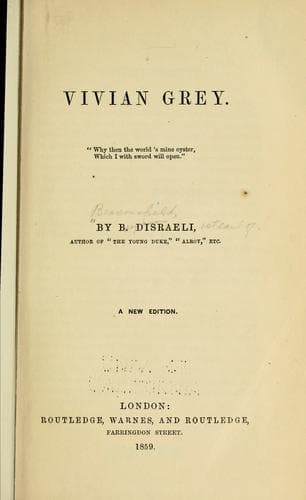
Vivian GreyDisraeli, Benjamin, Earl of Beaconsfield
ReligionIslamic
Vivian Grey
Disraeli, Benjamin, Earl of Beaconsfield
Bildungsromans; British -- Europe -- Fiction; Political fiction; Politicians -- Fiction; Young men -- Fiction
He opened a door at the farther end of the library, and introduced them
to a room of a different character. The sun, which was shining brightly,
lent additional brilliancy to the rainbow-tinted birds of paradise, the
crimson maccaws, and the green parroquets that glistened on the Indian
paper, which covered not only the walls, but also the ceiling of the
room. Over the fireplace a black frame, projecting from the wall, and
mournfully contrasting with the general brilliant appearance of the
apartment, inclosed a picture of a beautiful female; and bending over
its frame, and indeed partly shadowing the countenance, was the withered
branch of a tree. A harpsichord and several cases of musical instruments
were placed in different parts of the room; and suspended by broad black
ribbons from the wall, on each side of the picture, were a guitar and a
tambourine. On a sofa of unusual size lay a Cremona; and as Mr.
Beckendorff passed the instrument he threw by its side the bow, which he
had hitherto carried in his hand.
“We may as well now take something,” said Mr. Beckendorff, when his
guests had sufficiently admired the room; “my pictures are in my
dining-room; let us go there.”
So saying, and armed this time not only with his bow but also with his
violin, he retraced his steps through the library, and crossing a small
passage which divided the house into two compartments, he opened the
door into his dining-room. The moment they entered the room their ears
were saluted, and indeed their senses ravished, by what appeared to be a
concert of a thousand birds; yet none of the winged choristers were to
be seen, and not even a single cage was visible. The room, which was
simply furnished, appeared at first rather gloomy; for, though lighted
by three windows, the silk blinds were all drawn.
“And now,” said Mr. Beckendorff, raising the first blind, “you shall see
my pictures. At what do you estimate this Breughel?”
The window, which was of stained green glass, gave to the landscape an
effect similar to that generally produced by the artist mentioned. The
Prince, who was already puzzled by finding one who at the same time was
both his host and his enemy so different a character from what he had
conceived, and who, being by temper superstitious, considered that this
preliminary false opinion of his was rather a bad omen, did not express
any great admiration of the gallery of Mr. Beckendorff; but Vivian, who
had no ambitious hopes or fears to affect his temper, and who was amused
by the character with whom he had become so unexpectedly acquainted,
good-naturedly humoured the fantasies of the Minister, and said that he
preferred his picture to any Breughel he had ever seen.
“I see you have a fine taste,” said Mr. Beckendorff, with a serious air,
but in a courteous tone; “you shall see my Claude!”
The rich yellow tint of the second window gave to the fanciful garden
all that was requisite to make it look Italian.
Public-domain text, read in full here on John Shaqi.
Reviews
Reviews
No reviews yet
Be the first to share your thoughts on this work.
Elsewhere in the archive
Join the Discussion
Join the discussion
Sign in to leave a comment or review.
Sign InorCreate an account