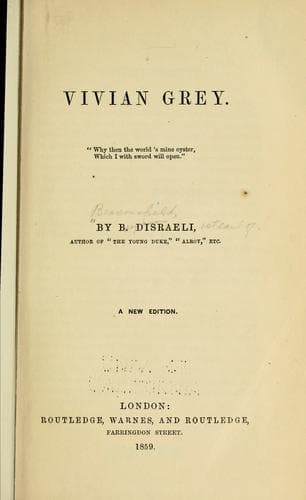
Vivian GreyDisraeli, Benjamin, Earl of Beaconsfield
ReligionIslamic
Vivian Grey
Disraeli, Benjamin, Earl of Beaconsfield
Bildungsromans; British -- Europe -- Fiction; Political fiction; Politicians -- Fiction; Young men -- Fiction
“Oh, my dear madam! when you know her as well as I do, you will see she
is always ready to put in a word.”
“Well! do you know, Dr. Sly, between ourselves, that was exactly my
impression; and she is then very, very—I do not exactly mean to say
meddling or inquisitive; but—but you understand me, Dr. Sly?”
“Perfectly; and if I were to speak my mind, which I do not hesitate to
do in confidence to you, Miss Graves, I really should say that she is
the most jealous, irritable, malicious, meddling, and at the same time
fawning, disposition that I ever met with in the whole course of my
life, and I speak from experience.”
“Well, do you know, Dr. Sly, from all I have seen, that was exactly my
impression; therefore I have been particularly careful not to commit
myself to such a person.”
“‘Ah! Miss Graves! if all ladies were like you! O--h!”
“My dear Dr. Sly!”
CHAPTER XVI
Vivian had duly acquainted the Marquess with the successful progress of
his negotiations with their intended partisans, and Lord Carabas had
himself conversed with them singly on the important subject. It was
thought proper, however, in this stage of the proceedings, that the
persons interested should meet together; and so the two Lords, and Sir
Berdmore, and Vivian were invited to dine with the Marquess alone, and
in his library.
There was abundance of dumb waiters and other inventions by which the
ease of the guests might be consulted, without risking even their secret
looks to the gaze of liveried menials. The Marquess’ gentleman sat in an
ante-chamber, in case human aid might be necessary, and everything, as
his Lordship averred, was “on the same system as the Cabinet Dinners.”
In the ancient kingdom of England it hath ever been the custom to dine
previously to transacting business. This habit is one of those few which
are not contingent upon the mutable fancies of fashion, and at this day
we see Cabinet Dinners and Vestry Dinners alike proving the correctness
of our assertion. Whether the custom really expedites the completion or
the general progress of the business which gives rise to it, is a grave
question, which we do not feel qualified to decide. Certain it is that
very often, after the _dinner_, an appointment is made for the
transaction of the _business_ on the following morning: at the same time
it must be remembered that, had it not been for the opportunity which
the banquet afforded of developing the convivial qualities of the
guests, and drawing out, by the assistance of generous wine, their most
kindly sentiments and most engaging feelings, it is very probable that
the appointment for the transaction of the business would never have
been made at all.
Public-domain text, read in full here on John Shaqi.
Reviews
Reviews
No reviews yet
Be the first to share your thoughts on this work.
Join the Discussion
Join the discussion
Sign in to leave a comment or review.
Sign InorCreate an account