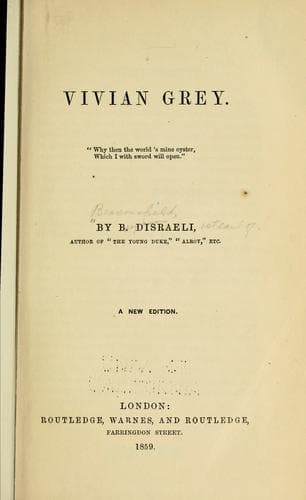
Vivian GreyDisraeli, Benjamin, Earl of Beaconsfield
ReligionIslamic
Vivian Grey
Disraeli, Benjamin, Earl of Beaconsfield
Bildungsromans; British -- Europe -- Fiction; Political fiction; Politicians -- Fiction; Young men -- Fiction
There certainly was every appearance that “the great business,” as the
Marquess styled it, would not be very much advanced by the cabinet
dinner at Château Desir. For, in the first place, the table was laden
“with every delicacy of the season,” and really, when a man is either
going to talk sense, fight a duel, or make his will, nothing should be
seen at dinner save cutlets and the lightest Bordeaux. And, in the
second place, it must be confessed, that when it came to the point of
all the parties interested meeting, the Marquess’ courage somewhat
misgave him. Not that any particular reason occurred to him which would
have induced him to yield one jot of the theory of his sentiments, but
the putting them in practice rather made him nervous. In short, he was
as convinced as ever that he was an ill-used man, of great influence and
abilities; but then he remembered his agreeable sinecure and his
dignified office, and he might not succeed. The thought did not please.
But here they were all assembled; receding was impossible; and so the
Marquess took a glass of claret, and felt more courageous.
“My Lords and Gentlemen,” he began, “although I have myself taken the
opportunity of communicating to you singly my thoughts upon a certain
subject, and although, if I am rightly informed, my excellent young
friend has communicated to you more fully upon that subject; yet, my
Lords and Gentlemen, I beg to remark that this is the first time that we
have collectively assembled to consult on the possibility of certain
views, upon the propriety of their nature, and the expediency of their
adoption.” (Here the claret passed.) “The present state of parties,” the
Marquess continued, “has doubtless for a long time engaged your
attention. It is very peculiar, and although the result has been
gradually arrived at, it is nevertheless, now that it is realised,
startling, and not, I apprehend, very satisfactory. There are few
distinctions now between the two sides of the House of Commons, very
different from the times in which most, I believe all, of us, my Lords
and Gentlemen, were members of that assembly. The question then
naturally arises, why a certain body of individuals, who now represent
no opinions, should arrogate to themselves the entire government and
control of the country? A second question would occur, how they contrive
to succeed in such an assumption? They succeed clearly because the
party who placed them in power, because they represented certain
opinions, still continue to them their support. Some of the most
influential members of that party, I am bold to say, may be found in
this room. I don’t know, if the boroughs of Lord Courtown and Lord
Beaconsfield were withdrawn at a critical division, what might be the
result. I am quite sure that if the forty country gentlemen who follow,
I believe I am justified in saying, our friend Sir Berdmore, and wisely
follow him, were to declare their opposition to any particular tax, the
Public-domain text, read in full here on John Shaqi.
Reviews
Reviews
No reviews yet
Be the first to share your thoughts on this work.
Join the Discussion
Join the discussion
Sign in to leave a comment or review.
Sign InorCreate an account