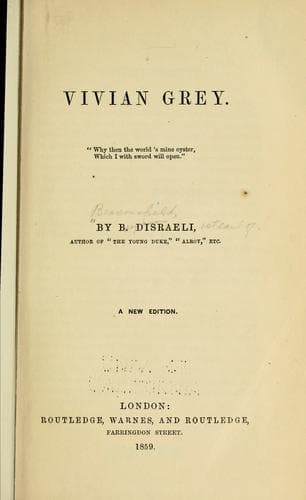
Vivian GreyDisraeli, Benjamin, Earl of Beaconsfield
ReligionIslamic
Vivian Grey
Disraeli, Benjamin, Earl of Beaconsfield
Bildungsromans; British -- Europe -- Fiction; Political fiction; Politicians -- Fiction; Young men -- Fiction
“Max Rodenstein was the glory of his house. A being so beautiful in body
and in soul you cannot imagine, and I will not attempt to describe. This
miniature has given you some faint idea of his image, and yet this is
only the copy of a copy. The only wish of the Baroness Rodenstein, which
never could be accomplished, was the possession of a portrait of her
youngest son, for no consideration could induce Max to allow his
likeness to be taken. His old nurse had always told him that the moment
his portrait was taken he would die. The condition upon which such a
beautiful being was allowed to remain in the world was, she always said,
that his beauty should not be imitated. About three months before the
battle of Leipsic, when Max was absent at the University, which was
nearly four hundred miles from Rodenstein Castle, there arrived one
morning a large case directed to the Baroness. On opening it it was
found to contain a picture, the portrait of her son. The colouring was
so vivid, the general execution so miraculous, that for some moments
they forgot to wonder at the incident in their admiration of the work of
art. In one corner of the picture, in small characters yet fresh, was an
inscription, which on examining they found consisted of these words:
‘Painted last night. Now, lady, thou hast thy wish.’ My aunt sank into
the Baron’s arms.
“In silence and in trembling the wonderful portrait was suspended over
the fireplace of my aunt’s favourite apartment. The next day they
received letters from Max. He was quite well, but mentioned nothing of
the mysterious painting.
“Three months afterwards, as a lady was sitting alone in the Baroness’s
room, and gazing on the portrait of him she loved right dearly, she
suddenly started from her seat, and would have shrieked, had not an
indefinable sensation prevented her. The eyes of the portrait moved. The
lady stood leaning on a chair, pale, and trembling like an aspen, but
gazing steadfastly on the animated portrait. It was no illusion of a
heated fancy; again the eyelids trembled, there was a melancholy smile,
and then they closed. The clock of Rodenstein Castle struck three.
Between astonishment and fear the lady was tearless. Three days
afterwards came the news of the battle of Leipsic, and at the very
moment that the eyes of the portrait closed Max Rodenstein had been
pierced by a Polish Lancer.”
“And who was this wonderful lady, the witness of this wonderful
incident?” asked Vivian.
“That lady was myself.”
There was something so singular in the tone of Mrs. Felix Lorraine’s
voice, and so peculiar in the expression of her countenance, as she
uttered these words, that the jest died on Vivian’s tongue; and, for
want of something better to do, he lashed the little ponies, which were
already scampering at their full speed.
Public-domain text, read in full here on John Shaqi.
Reviews
Reviews
No reviews yet
Be the first to share your thoughts on this work.
Elsewhere in the archive
Join the Discussion
Join the discussion
Sign in to leave a comment or review.
Sign InorCreate an account