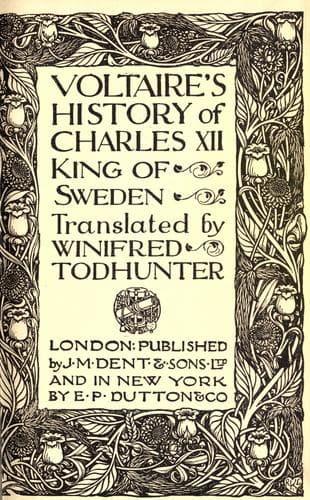
Voltaire's history of Charles XII, king of SwedenVoltaire
Philosophy
Voltaire's history of Charles XII, king of Sweden
Voltaire
Charles XII, King of Sweden, 1682-1718
The severe discipline under which Charles’s troops lived is well known;
they did not pillage towns taken by assault without permission; they
pillaged in an orderly way, and desisted at the first signal. The
Swedes boast to this day of the discipline they kept in Saxony: yet the
Saxons complain that the most terrible outrages were committed among
them. These contradictory statements would be irreconcilable if we did
not remember that men look at the same thing from different points of
view.
It would have been very strange had not the conquerors sometimes abused
their privileges, and had not the conquered regarded the smallest
damage as the most terrible injury. One day as the King was riding
near Leipzig a Saxon peasant threw himself at his feet to ask justice
against a grenadier, who had just gone off with what he had intended
for his family dinner. The King had the soldier called. “Is it true,”
he asked sternly, “that you have robbed this man?” “Sire,” answered the
soldier, “I have not done him so much harm as your Majesty has done his
master, for you have stolen a kingdom from him, while I have only taken
a turkey from this rustic.” The King gave the peasant ten ducats, and
pardoned the soldier for the boldness of the repartee, but he added,
“Remember, friend, that I have taken a kingdom from King Augustus, but
I have taken nothing for myself.”
The great Leipzig fair was held as usual, tradesmen attended it in
perfect security; not one Swedish soldier was to be seen in the fair;
it might have been said that the only object of the Swedish army in
Saxony was to keep the peace: the King ruled throughout the Electorate
with as absolute a power and as deep a tranquillity as in Stockholm.
King Augustus, a wanderer in Poland, and deprived both of his kingdom
and his electorate, at last wrote a letter with his own hand to Charles
XII to ask for a peace.
He commissioned Baron Imhof, accompanied by M. Finsten of the Privy
Council, secretly to deliver this letter; he gave them full powers
and _carte blanche_, directing them to try to obtain for him
reasonable and Christian conditions. He was obliged to conceal his
overtures for peace and to refrain from having recourse to the
mediation of any prince, for being then in Poland, at the mercy of
the Russians, he had reason to fear that the dangerous ally whom
he had abandoned would take vengeance on him for his submission to
the conqueror. His two plenipotentiaries came by night to Charles’s
camp and had a private audience. The King read the letter, and said,
“Gentlemen, you shall have your answer in a moment.” Then he went into
his office and wrote as follows--
“I consent to grant peace on the following conditions, in which it must
not be expected that I will make the least alteration:--
“1. That King Augustus renounce for ever the crown of Poland, that he
acknowledge Stanislas as lawful king; and that he promise never to
recover the throne, even after the death of Stanislas.
Public-domain text, read in full here on John Shaqi.
Reviews
Reviews
No reviews yet
Be the first to share your thoughts on this work.
Elsewhere in the archive
Join the Discussion
Join the discussion
Sign in to leave a comment or review.
Sign InorCreate an account