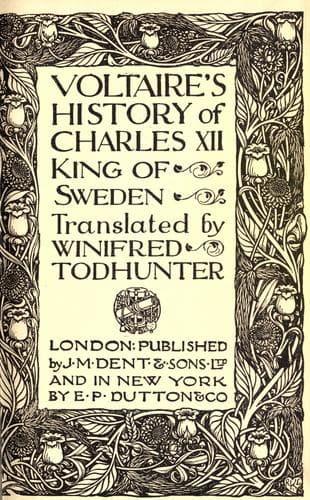
Voltaire's history of Charles XII, king of SwedenVoltaire
Philosophy
Voltaire's history of Charles XII, king of Sweden
Voltaire
Charles XII, King of Sweden, 1682-1718
The third and last of his demands was the most exorbitant. He declared
himself protector of the Emperor’s Protestant subjects in Silesia, a
province of the House of Austria, and not of the Empire; he wanted
the Emperor to grant them the liberties and privileges which had been
gained by the Treaty of Westphalia, but nullified, or at least eluded,
by the Treaty of Ryswick. The Emperor, whose great aim was to get
rid of so dangerous a neighbour, still assented, and granted him all
that he wanted. The Lutherans obtained more than 100 churches, which
the Catholics were obliged to cede by this treaty, but many of these
concessions, secured for them by the King of Sweden’s fortune, were
taken from them as soon as he could no longer impose laws.
The Emperor, who was forced to make these concessions, and who
submitted to Charles’s wishes in everything, was Joseph, the eldest
son of Leopold, and brother of Charles VI, who succeeded him. The
Pope’s nuncio, who then resided in the court of Joseph, reproached him
severely for ceding, as a Catholic, the interests of his own religion
to the heretics. “It is very lucky for you,” answered the Emperor,
smiling, “that the King of Sweden did not propose that I should turn
Protestant, for had he done so I do not know what I might have done.”
Count Wratislau, his ambassador to Charles XII, brought the treaty
in favour of the Silesians, and signed by his master, to Leipzig.
Charles then said he was satisfied, and the firm friend of the Emperor.
But he was disgusted that Rome had opposed him to the utmost of her
ability. He felt the greatest contempt for the weakness of the Court,
which being at present the irreconcilable enemy of half Europe, always
distrusts the other half, and only maintains its credit by its skilful
diplomacy. He seemed determined on vengeance. He told Count Wratislau
that the Swedes had once subjugated Rome, and that they had not
degenerated as she had done.
He let the Pope know that he would one day demand the effects which
Queen Christina had left at Rome. It is impossible to say how far this
young conqueror would have carried his resentment and his arms, had
fortune seconded his designs. Nothing then seemed an impossibility to
him; he even sent several officers secretly to Asia, and as far as
Egypt, to take plans of the towns and inform him of the strength of
those countries. Certainly, if any one were capable of overturning the
empire of the Persians and Turks, and then going on into Italy, it was
Charles XII. He was as young as Alexander, as great a soldier, and as
daring; but he was more indefatigable, stronger, and more temperate;
then the Swedes, too, were perhaps better men than the Macedonians. But
such plans, which are called divine when they succeed, are regarded as
chimeras when they fail.
Public-domain text, read in full here on John Shaqi.
Reviews
Reviews
No reviews yet
Be the first to share your thoughts on this work.
Elsewhere in the archive
Join the Discussion
Join the discussion
Sign in to leave a comment or review.
Sign InorCreate an account