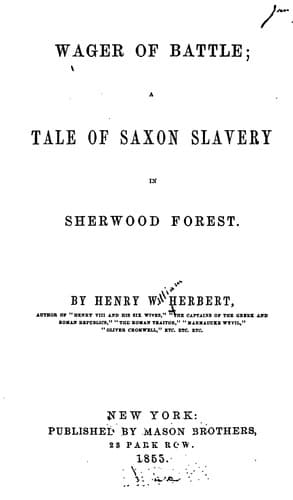
Wager of Battle: A Tale of Saxon Slavery in Sherwood ForestHerbert, Henry William
History
Wager of Battle: A Tale of Saxon Slavery in Sherwood Forest
Herbert, Henry William
Anglo-Saxons -- Fiction; Great Britain -- History -- Norman period, 1066-1154 -- Fiction; Sherwood Forest (England) -- Fiction
It was his hope to gain sufficient start, in the first instance, to
enable him to make off so long before his absence should be
discovered, that bloodhounds could not be laid on his track until the
scent should be already cold; and then keeping the forest-ground, and
avoiding all cleared or cultivated lands, to cross the Lancaster
sands, and thence, by following up the course of the Kent River, on
which he knew Kenric would be stationed as verdurer, to gain the
interior labyrinth of fells, moors, morasses, and ravines, which at
that time occupied the greater part of Westmoreland and Cumberland.
To this end, he managed to conceal himself at nightfall not far from
the quarter, before the serfs had collected in their dormitory,
intending to prosecute his flight so soon as the neighborhood should
be steeped in the silence of night, and the moon should give him
sufficient light to find his way through the deep forest mazes; and
thus, before daybreak, was already some twenty miles distant from
Waltheofstow, where he concealed himself in a deep hazel brake,
intending to sleep away the hours of daylight, and resume his flight
once more during the partial darkness of the night.
It was true that his route lay through the woodland-chase, which
spread far and wide over the environs of Fenton in the Forest, and was
the property of his new master; but for this he cared little, since
there had been so small intercourse between the tenantry and vassals
of his late lord and those of Sir Foulke d'Oilly, that he had no fears
of being recognized by any chance retainer whom he might possibly
encounter, while he knew that, should he chance to be discovered by a
passing serf of his own oppressed race, he should not be betrayed by
them to their mutual tyrants. Armed, therefore, at large, and already
at a considerable distance from the scene of his captivity, he
considered himself well-nigh safe when he concealed himself, in the
early gray of the dawn, in such a dingle as he felt sure would secure
him from the chance intrusion of any casual wayfarers.
Under one difficulty, however, he sorely labored. He had been unable
to carry with him any provision, however slender; and he must depend
on his skill as a forester for his sustenance, by poaching in the
woods which he had to traverse, and cooking his game as best he might,
borrowing an hour or two of the darkness for the purpose, and kindling
his fire in the most remote and obscure places, to avoid danger of the
smoke being observed by day, or the glare of the fire by night.
He had lost his evening meal on the previous day, and the appetite of
the Saxon peasant was proverbially mighty; while, as is ever the case
with men who have no motives to self-restraint or economy, abstinence
was an unknown power.
Public-domain text, read in full here on John Shaqi.
Reviews
Reviews
No reviews yet
Be the first to share your thoughts on this work.
Elsewhere in the archive
Join the Discussion
Join the discussion
Sign in to leave a comment or review.
Sign InorCreate an account