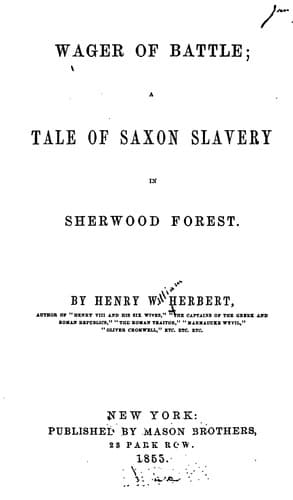
Wager of Battle: A Tale of Saxon Slavery in Sherwood ForestHerbert, Henry William
History
Wager of Battle: A Tale of Saxon Slavery in Sherwood Forest
Herbert, Henry William
Anglo-Saxons -- Fiction; Great Britain -- History -- Norman period, 1066-1154 -- Fiction; Sherwood Forest (England) -- Fiction
At the very moment in which the serf had launched his fatal bolt
against the deer, the bailiff, Ralph Wetheral, who was, by virtue of
his office, better acquainted with his person than any others of the
household, was within a half a mile of his lair, engaged in tracking
up the slot of the very animal which he was rejoicing to have slain,
by aid of a mute lymer, or slow-hound, of an especial breed, kept and
trained for the purpose; and in furtherance of his pursuit, had
dismounted from his horse, and was following the dog as he dragged him
onward, tugging at the leash; while ten or fifteen of his companions
were scattered through the woods behind him, beating them carefully,
in order to track the stags or wild boars to their lairs, before the
arrival of their lord.
It was, perhaps, half an hour after he had discharged the shot, when
he was alarmed by a light rustling of the under-wood and the cracking
of dry sticks under a cautious footstep, and at first surmised that a
second beast of chase was following on the track of his predecessor.
But, in a moment, he was undeceived, by hearing the voice of a man
whispering a few low words of encouragement to a dog, and at once the
full extent of his danger flashed upon him. The dog was evidently
questing the animal he had shot, and, within an instant, would lead
his master to the spot. Under the cruel enactment of the Norman
forest-laws, to slay a deer was a higher offense than to kill a
fellow-man; the latter crime being in many cases remissible on the
payment of a fine, while the former inevitably brought down on the
culprit capital punishment, often enhanced by torture. To be found
hidden, close behind a warm and yet bleeding stag, was tantamount to
being taken red-handed in the fact, and instant death was the least
punishment to be looked for.
Discovery was so close at hand, that flight itself seemed impossible;
yet in immediate flight lay the sole chance of safety. He had already
started from his lair, when the slow-hound, coming on the track of the
fresh blood, set up a wild and savage yell, broke from the leash, and
in a second was standing over the slaughtered quarry, tearing away
with his fangs and claws the bushes which covered the carcass.
At the same moment, the branches were parted, and the bailiff of
Waltheofstow stood before the culprit, carrying an unbended long-bow
in his hand, and having a score of cloth-yard arrows at his belt, a
short anlace at his side, and his bugle slung about his neck.
The recognition on each side was immediate, and the Norman advanced
fearlessly to seize the fugitive, raising his bugle to his lips, as he
came on, to summon succor. But Eadwulf, who had already laid a quarrel
in the groove of the crossbow, with some indefinite idea of shooting
the dog before the man should enter upon the scene, raised the weapon
quickly to his shoulder, and, taking rapid aim, discharged it full at
the breast of the bold intruder.
Public-domain text, read in full here on John Shaqi.
Reviews
Reviews
No reviews yet
Be the first to share your thoughts on this work.
Elsewhere in the archive
Join the Discussion
Join the discussion
Sign in to leave a comment or review.
Sign InorCreate an account