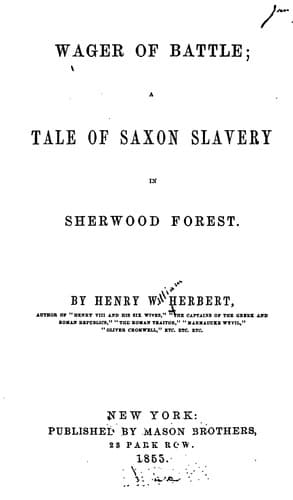
Wager of Battle: A Tale of Saxon Slavery in Sherwood ForestHerbert, Henry William
History
Wager of Battle: A Tale of Saxon Slavery in Sherwood Forest
Herbert, Henry William
Anglo-Saxons -- Fiction; Great Britain -- History -- Norman period, 1066-1154 -- Fiction; Sherwood Forest (England) -- Fiction
Then their deep clamor ceased at once, where he had turned on his back
track, and he knew they were at fault, and perceived that the men, by
their vociferations and bugle-notes, were casting them to and fro in
all directions, to recover his scent.
Still he swam rapidly onward, and had interposed nearly another mile
between himself and his pursuers, when he heard, by their shouts
coming down either bank, that they had divined the stratagem to which
he had had recourse, and were trailing him down the margins, secure of
striking his track again, wherever he should leave the river.
He was again becoming very anxious, when a singular accident gave him
another chance of safety. A wood-pigeon, flapping its wings violently
as it took flight, attracted his attention to the tree from which it
took wing. It was a huge oak, overhanging the stream, into which one
of its branches actually dipped, sound and entire below, but with a
large hollow at about twenty feet from the ground, which, as he easily
divined, extended downward to the level of the soil. No sooner seen,
than he had seized the pendulous branch, swung himself up by it,
through a prodigious exertion, and, springing with mad haste from
bough to bough, reached the opening in the decayed trunk. It was a
grim, dark abyss, and, should he enter it, he saw not how he should
ever make his exit. But a nearer shout, and the sounds of galloping
horsemen, decided him. He entered it foot-foremost, hung by his hands
for a moment to the orifice, in hesitation, and then, relaxing his
hold, dropped sheer down through the rotten wood, and spiders'-webs,
and unhealthy funguses, to the bottom of the tunnel-shaped hollow.
Aroused from their diurnal dreams by the crash of his descent, two
great brown-owls rushed out of the summit of the tree, and swooped
down over the heads of the men-at-arms, who just at the instant passed
under the branches, jingling in their panoply, and effectually
prevented any suspicion from attaching to the hiding-place.
For the moment he was safe; and there he stood, in almost total
darkness, shivering with wet and cold, amid noisome smells and damp
exhalations, listening to the shouts of his enemies, as they rode to
and fro, until they were lost in the distance.
CHAPTER XVII.
THE PURSUIT.
"Now tell me thy name, good fellow, said he,
Under the leaves of lyne.
Nay, by my faith, quoth bold Robin,
Till thou have told mo thine."
ROBIN HOOD AND GUY OF GISBORNE.
Public-domain text, read in full here on John Shaqi.
Reviews
Reviews
No reviews yet
Be the first to share your thoughts on this work.
Elsewhere in the archive
Join the Discussion
Join the discussion
Sign in to leave a comment or review.
Sign InorCreate an account