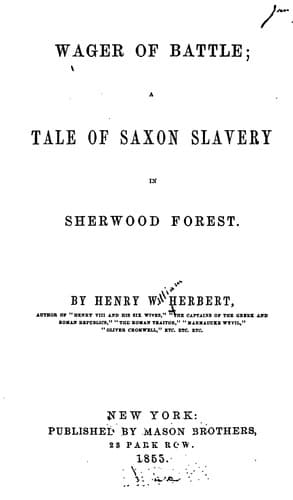
Wager of Battle: A Tale of Saxon Slavery in Sherwood ForestHerbert, Henry William
History
Wager of Battle: A Tale of Saxon Slavery in Sherwood Forest
Herbert, Henry William
Anglo-Saxons -- Fiction; Great Britain -- History -- Norman period, 1066-1154 -- Fiction; Sherwood Forest (England) -- Fiction
It might have been ten o'clock in the evening when he left the
oak-tree, and, though weary and hungry, he plodded forward at a steady
pace, never falling short of four miles an hour, and often greatly
exceeding that speed, where the ground favored his running, until
perhaps an hour before daybreak. At that darkest moment of the night,
after the moon had set, he paused in a little hollow of the hills,
having placed, as he calculated, at least five-and-thirty miles
between himself and his hunters, lighted a fire, cooked a portion of
his venison, and again, just as the skies began to brighten, got under
way, supposing that at about this hour his foes would resume their
search, and might probably in a couple of hours get the hounds again
upon his scent. Ere that, however, he should have gained another ten
miles on them, and he well knew that the scent would be so cold that
it would be many hours more before they could hunt it up, if they
should succeed in doing so at all.
All day, until the sun was high at noon, he strode onward across the
barren heath and wild moors into which the forest had now subsided,
when, after catching from a hill-top a distant view of a town and
castle to the northward, which he rightly judged to be Skipton, he
reached an immense tract, seeming almost interminable, of green, oozy
morasses, cut up by rivulets and streamlets, and often intersected by
dangerous bogs, from which flowed the interlinked tributaries of the
Eyre, the Ribble, and the Hodder. Through this tract, he was well
aware, neither horse could follow nor bloodhound track him; and it was
overgrown in so many places with dense brakes of willow and alder,
that his flight could not be discovered by the eye from any of the
surrounding eminences. Into this dreary region he, therefore, plunged
joyously, feeling half-secure, and purposely selecting the deepest and
wettest portions of the bog, and, where he could do so without losing
the true line of his course, wading along the water-courses until
about two in the afternoon, when he reached an elevated spot or island
in the marsh, covered with thrifty underwood, and there, having fed
sparingly on the provision he had cooked on the last evening, made
himself a bed in the heather, and slept undisturbed, and almost
lethargically, until the moon was up in the skies. Then he again
cooked and ate; but, before resuming his journey, he climbed a small
ash-tree, which overlooked the level swamp, and thence at once
descried three watch-fires, blazing brilliantly at three several spots
on the circumference of the morass, one almost directly ahead of him,
and nearly at the spot where he proposed to issue on to the wild
heathery moors of Bolland Forest, on the verge of the counties of York
and Lancaster, and within fifty miles of the provincial capital and
famous sands of the latter. By these fires he judged easily that thus
far they had traced him, and found the spot where he had entered the
Public-domain text, read in full here on John Shaqi.
Reviews
Reviews
No reviews yet
Be the first to share your thoughts on this work.
Elsewhere in the archive
Join the Discussion
Join the discussion
Sign in to leave a comment or review.
Sign InorCreate an account