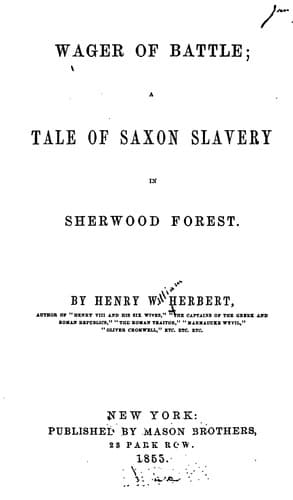
Wager of Battle: A Tale of Saxon Slavery in Sherwood ForestHerbert, Henry William
History
Wager of Battle: A Tale of Saxon Slavery in Sherwood Forest
Herbert, Henry William
Anglo-Saxons -- Fiction; Great Britain -- History -- Norman period, 1066-1154 -- Fiction; Sherwood Forest (England) -- Fiction
"Up with thee, Wolfric," cried one of the men to one who seemed the
chief. "Up with thee! There is no time to lose. We must swear him
when we have entered the cave. Forward comrade; this way lies your
safety." And, with the words, he pointed up the slippery chasm of the
waterfall.
Up this perilous ladder, one by one, where to an unpracticed eye no
ascent appeared possible, the outlaws straggled painfully but in
safety, the spray effacing every track of their footsteps, and the
water carrying off every trace of the scent where they had passed,
until they reached the topmost landing-place. There the stream was
projected in an arch from the rock, which jutted out in a bold table;
and there, stooping under the foamy sheet, the leader entered a low
cavern, with a mouth scarce exceeding that of a fox earth, but
expanding within into a large and roomy apartment, where they ate and
caroused and slept at their ease, during the whole day and all the
succeeding night; for the robbers insisted that no foot must be set
without their cavern by the fugitive, until they should have
ascertained by their spies that the Normans had quitted their
neighborhood. This they did not until late in the following day, when
they divided themselves into three parties, and struck off
northwesterly toward the upper sands at the head of the bay, for which
they had evidently concluded that Eadwulf was making, after they had
exhausted every effort of ingenuity to discover the means of his
inexplicable disappearance, on the verge of that tiny rivulet, running
among open moors on the bare hill-sides.
So soon as they were certain of the direction which the enemy had
taken, and of the fact that they had abandoned the farther use of the
bloodhounds, as unprofitable, the whole party struck due westerly
across the hills, on a right line for Lancaster, guiding their
companion with unerring skill across some twenty miles of
partially-cultivated country, to the upper end of the estuary of the
Lon, about one mile north of the city, which dreary water they reached
in the gloaming twilight. Here a skiff was produced from its
concealment in the rushes, and he was ferried over the frith, as a
last act of kindness, by his entertainers, who, directing him on his
way to the sands, the roar of which might be heard already in the
distance, retreated with all speed to their hill fastnesses, from
which they felt it would be most unsafe for them to be found far
distant by the morning light.
The distance did not much exceed four miles; but, before he arrived at
the end, Eadwulf met the greatest alarm which had yet befallen him;
for, just as it was growing too dark to distinguish objects clearly, a
horseman overtook him, or rather crossed him from the northward,
riding so noiselessly over the sands, that he was upon him before he
heard the sound of his tread.
Public-domain text, read in full here on John Shaqi.
Reviews
Reviews
No reviews yet
Be the first to share your thoughts on this work.
Elsewhere in the archive
Join the Discussion
Join the discussion
Sign in to leave a comment or review.
Sign InorCreate an account