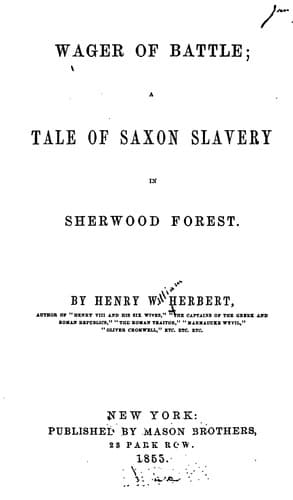
Wager of Battle: A Tale of Saxon Slavery in Sherwood ForestHerbert, Henry William
History
Wager of Battle: A Tale of Saxon Slavery in Sherwood Forest
Herbert, Henry William
Anglo-Saxons -- Fiction; Great Britain -- History -- Norman period, 1066-1154 -- Fiction; Sherwood Forest (England) -- Fiction
Another moment, and it rose bodily from the water, floated upward into
the skies, and left all below laughing, clear in the sunlight. There
was no sand now to be seen, save a narrow yellow stripe on the edge of
the soft verdant points, which stretched out from the shores of
Westmoreland, sparkling in the sun and glittering in the rain-drops,
into the broad bosom of Morecambe Bay, which was now filled with the
tide, though it had not as yet nearly risen to its highest mark--but
here and there, at intervals, dark spots showed in the expanse of
waters, where the tops of the highest sand-banks were scarcely
submerged at all, on which the gentle eddies rippled and sparkled, as
wavelet after wavelet rolled in by its own mounting impulse, but
hastened by no angry gust or turbulent billow.
On one of these sand-banks, having so long escaped, Heaven knows how,
quicksands and breakers, and having made his way thus far landward,
sat a tall, powerful man-at-arms, sheathed from head to heel in a
complete panoply of chain mail. His horse was likewise caparisoned in
the heaviest bardings--chamfront and poitrel, steel demipique and
bard proper--nothing was wanting of the heaviest caparison with which
charger or man ever rode into the tilt-yard or mêlée.
The tide was already above the horse's belly, and the rider's plated
shoes and mail hose were below the surface. Deep water was around him
on every side, the nearest shore a mile distant, and to swim fifty
yards, much less a mile, under that weight of steel, was impossible;
still he sat there, waiting his doom, silent and impassive.
He was the last of the pursuers; he alone of the two parties, who but
three short hours before had spurred so fiercely in pursuit of the
wretched slave, had escaped the fate of Pharaoh and his host, when the
Red Sea closed above them. He alone breathed the breath of life; and
he, certain of death, awaited it with that calm composure, which comes
to the full as much of artificial training as of innate valor.
As the clouds lifted, this solitary man saw, at once, the boat
approaching, and saw who rowed it--saw rescue close at hand, yet at
the same time saw it impossible. His face had hardly the time to relax
into one gleam of hope, before it again settled down into the iron
apathy of despair.
The coracle swept up abreast of him, then paused, as Eadwulf, half
unconsciously, rested on his oars, and gazed into the despairing and
blank features of his enemy. It was the seneschal of Waltheofstow, the
brother of the man whom he had slain in the forest.
Their eyes met, they recognized each other, and each shuddered at the
recognition. For a moment, neither spake; but, after a short, bitter
pause, it was the rider who broke silence.
"So, it is thou, Saxon dog, who alone hast escaped from this
destruction!"
"It is I, man-hunter. Where are thy boasts and threats now? Why dost
not ask the serf, now, for life, for mercy?"
Public-domain text, read in full here on John Shaqi.
Reviews
Reviews
No reviews yet
Be the first to share your thoughts on this work.
Elsewhere in the archive
Join the Discussion
Join the discussion
Sign in to leave a comment or review.
Sign InorCreate an account