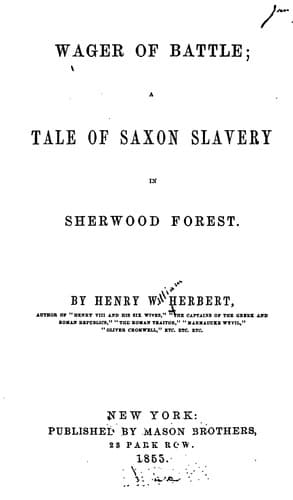
Wager of Battle: A Tale of Saxon Slavery in Sherwood ForestHerbert, Henry William
History
Wager of Battle: A Tale of Saxon Slavery in Sherwood Forest
Herbert, Henry William
Anglo-Saxons -- Fiction; Great Britain -- History -- Norman period, 1066-1154 -- Fiction; Sherwood Forest (England) -- Fiction
Altogether he was, however, a remarkably attractive-looking person. He
sat his horse superbly, as a king might sit his throne; his every
motion was perfect majesty of grace; and when he smiled, so radiant
was the glance lighting up the dark face, that he was, for the moment,
actually handsome. He was dressed in a plain, dark hunting suit, with
a bonnet and feather of the same hue, and untanned deer buskins, the
only ornament he wore being a long blue scarf, of the same color as
the surcoat of his mistress, and embroidered, probably by her hand,
with the same bearings. The spurs in his buskins, however, were not
gilded, and the light estoc, or sharp-pointed hunting-sword, which
hung at his left side, showed by its form that he had not yet attained
the honors of knighthood.
Aradas de Ratcliffe was the heir male of a line, one of the first and
noblest which had settled in the lake country, in the beautiful vale
of Rydal, but a little way distant to the northward from the lands of
Sir Yvo de Taillebois. His father, a baron of great renown, had taken
the Cross when far advanced in life, and proceeding to the Holy Land
with that disastrous Second Crusade, led by Conrad III. the German
Emperor, and Louis VII. of France, at the summoning of Pope Eugene
III., had fallen in the first encounter with the infidels, and dying
under shield, knight-like, had left his infant son with no other
guardian than his mother, a noble lady of the house of Fitz Norman.
She had discharged her trust as became the character of her race; and
so soon as the boy was of sufficient years, he was entered in the
household of Sir Yvo de Taillebois, as the finest school in the whole
realm for the aspirant to honor in arms.
Here, as page and esquire, he had served nearly twenty years of his
life, first following his lord's stirrup, until he was perfect in the
use of his arms, and old enough to wield them; then, fighting in his
train, until he had proved himself of such stern fidelity and valor,
that he became his favorite attendant, and most trusted man-at-arms.
In feudal days, it must be remembered that it was no disgrace to a
scion of the highest family to serve his pagehood under a noble or
knight of lineage and renown; on the contrary, it was both a condition
that must be undergone, and one held as an honor to both parties; so
much so, that barons of the greatest name and vastest demesnes in the
realm would often solicit, and esteem it as a high favor, to have
their sons ride as pages in the train of some almost landless knight,
whose extraordinary prowess should have won him an extraordinary name.
Public-domain text, read in full here on John Shaqi.
Reviews
Reviews
No reviews yet
Be the first to share your thoughts on this work.
Elsewhere in the archive
Join the Discussion
Join the discussion
Sign in to leave a comment or review.
Sign InorCreate an account