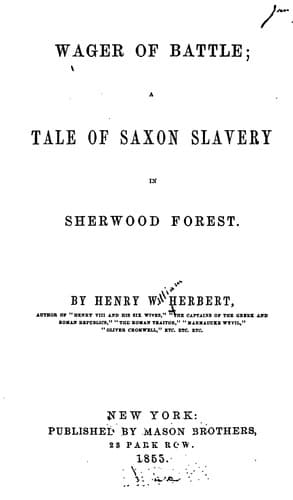
Wager of Battle: A Tale of Saxon Slavery in Sherwood ForestHerbert, Henry William
History
Wager of Battle: A Tale of Saxon Slavery in Sherwood Forest
Herbert, Henry William
Anglo-Saxons -- Fiction; Great Britain -- History -- Norman period, 1066-1154 -- Fiction; Sherwood Forest (England) -- Fiction
"Oh! yes, you will, Edith," he answered, quietly. "Oh! yes, you will,
for half a dozen reasons; though one is enough, for that matter.
First, you will not see my mother dead through your obstinacy. Second,
you will not stay to be outraged yourself, before my very eyes,
without my having power to aid you----"
"Kenric!"
"It is mere truth, Edith. Thirdly, it is your duty to go; and last, it
is my will that you go, and I never knew you refuse that."
"Nor ever will, Kenric; though it break my heart to do it."
"Tush! tush! girl; hearts are tough things, and do not break so
easily; and when you kiss me to-morrow at the castle, you'll think of
this no more. See, here's the boy with the pony and the pillion. Now,
hurry, and coax my mother out, and get on your cloak and wimple,
that's a good lass. I would not have you here when Foulke d'Oilly's
riders come, no! not to be the Lord of Kentmere. Hurry! hurry!"
Many minutes had not passed, before, after a long embrace, and a flood
of tears on the part of Edith, the two women mounted on the sturdy
pony, the wife in the saddle, and the aged mother seated on a sort of
high-backed pillion--made like the seat of an arm-chair--and secured
by a broad belt to the waist of her daughter, took their way across
the wooded hills toward Ambleside, the boy Ralph leading the animal by
the head, and two brace of noble alans, his master's property, which
Kenric did not choose to expose to the cupidity of his expected
captors, gamboling in front, or following gravely at heel, according
to their various qualities of age and temper.
The son and husband gazed after them wistfully, so long as they
remained in sight; and when, as they crossed the last ridge of the low
intermediate hills which divide the narrow glen of the upper Kent from
the broader dale of Windermere, standing out in bold relief against
the strong light of the western sky, Edith waved her kerchief, he drew
his hard hand across his brow, turned into his desolate dwelling, and,
sitting down by the hearth, was soon lost in gloomy meditation.
Darkness soon fell over lake and meadow, mountain and upland. Hundreds
of stars were twinkling in the clear sky, to which a touch of frost,
not unusual at this early season among those hill regions, had lent an
uncommon brilliance, but the moon had not yet risen.
Kenric was now becoming restless and impatient, and, as is frequently
the case when we are awaiting even the most painful things, which we
know to be inevitable, he soon found himself wishing that the time
would come, that he might know the worst, and feeling that the
suspense was worse than almost any reality.
Public-domain text, read in full here on John Shaqi.
Reviews
Reviews
No reviews yet
Be the first to share your thoughts on this work.
Elsewhere in the archive
Join the Discussion
Join the discussion
Sign in to leave a comment or review.
Sign InorCreate an account